MCAT® Test
This overview includes information to help you prepare for the MCAT® exam. You’ll find details about the exam format, registration, testing options, costs, scoring, retakes, and study resources.
Exam TypeMedical school admissions exam | Total Questions230 questions |
Test Time6 hours and 15 minutes of testing time | Total Score472 to 528 |
Exam Background and Purpose
The Medical College Admission Test® (MCAT®) is a standardized exam used by medical schools as part of the admissions process. The exam measures knowledge and reasoning skills in biological sciences, physical sciences, behavioral sciences, and critical analysis.
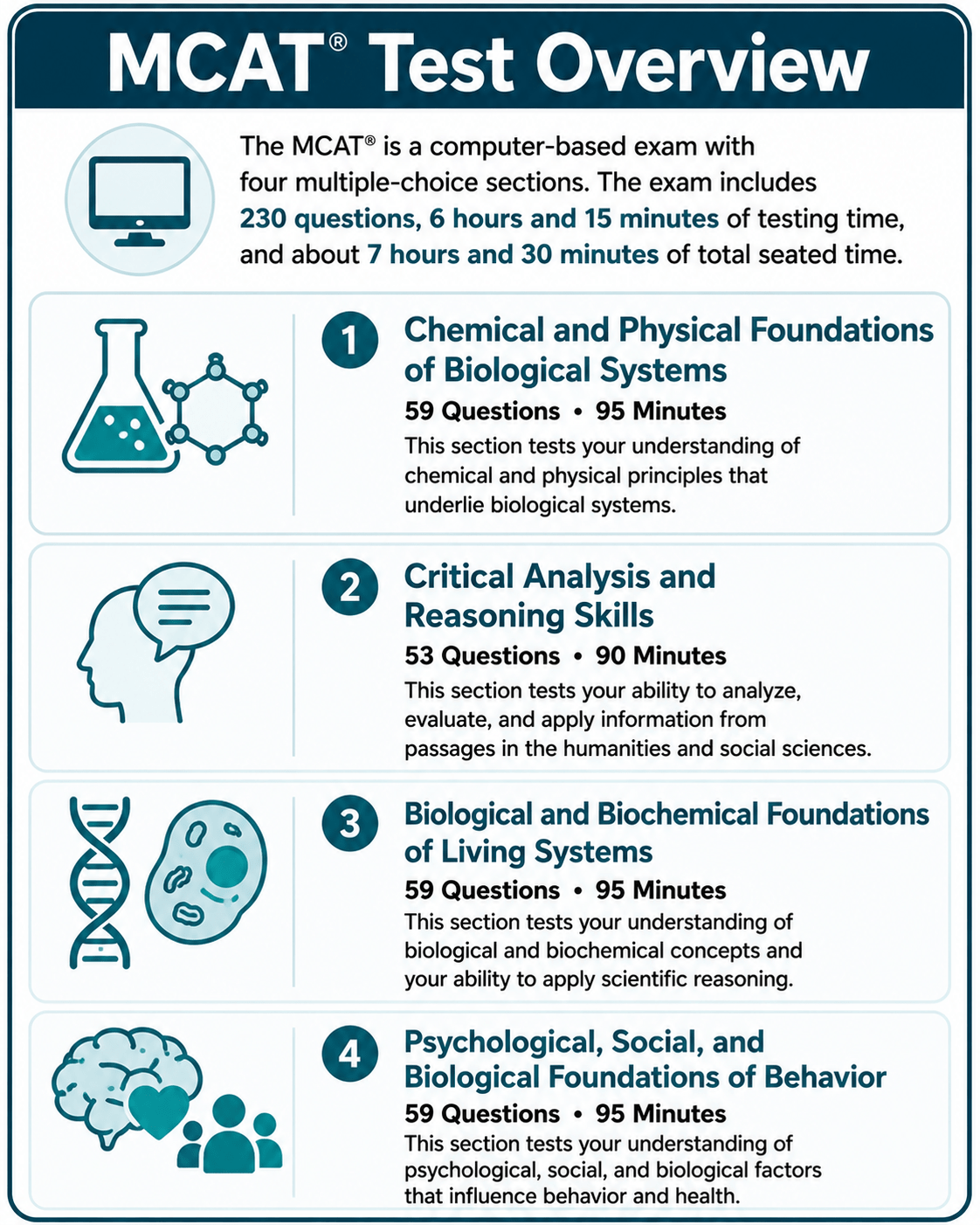
Test Overview
The MCAT is divided into four main sections. Each section measures a different combination of scientific knowledge, critical analysis, reasoning, and problem-solving skills.
Costs and Payment Options
The standard MCAT registration fee is currently $355. Examinees approved for the AAMC Fee Assistance Program pay a reduced registration fee of $145. Examinees testing outside the United States, Canada, or U.S. territories are charged an additional international fee. Because fees may change, check the official AAMC registration information before scheduling your exam.
Registration/Times/Locations
You can register for the MCAT through the AAMC MCAT Registration System. During registration, you will choose a test date, select a testing location, and pay the registration fee. MCAT testing dates are offered throughout the year, but availability depends on your location and open testing appointments.
Key point: MCAT fees, scheduling deadlines, available testing dates, and testing-center appointments can change, so always confirm the current details through AAMC before registering.
Test Day
Plan to arrive early and bring valid identification that matches the name on your MCAT registration. The MCAT is administered at a testing center, and you must follow AAMC’s test-day rules for check-in, breaks, personal items, and prohibited materials.
The MCAT includes optional scheduled breaks. Food, drinks, and personal items are not allowed in the testing room, but some items may be accessed during approved breaks according to test-center rules.
Test Scores
Each MCAT section is scored from 118 to 132. Your four section scores are combined to create a total score ranging from 472 to 528. There is no universal passing score for the MCAT; each medical school decides how it evaluates MCAT scores as part of its admissions process.
Official MCAT scores are typically released 30–35 days after your exam date.
Retaking the MCAT
You may retake the MCAT, but there are attempt limits. You may take the exam up to three times in one testing year, up to four times over two consecutive testing years, and up to seven times in your lifetime.
How Can I Prepare for the MCAT Test?
Preparing for the MCAT is easier when you use the right study tools. A study guide can help you review tested content, flashcards can reinforce important concepts, and practice tests can help you become familiar with the exam format and timing. Below, you’ll find MCAT prep resources designed to help you study efficiently and build confidence before test day.
MCAT Study Checklist
- Review the four MCAT sections and their timing.
- Study biology, chemistry, physics, biochemistry, psychology, and sociology concepts.
- Practice reading and analyzing complex passages.
- Use practice questions to identify weak areas.
- Review missed questions carefully.
- Use a study guide and flashcards to keep your prep organized.
- Check the medical schools where you plan to apply so you understand how they evaluate MCAT scores.
MCAT Study Resources
Top Study Guides:
Best Flashcards:
Test Resources:
Skill Building Exercises
MCAT® and Medical College Admission Test® are registered trademarks of the Association of American Medical Colleges. AAMC is not involved with or affiliated with Mometrix Media LLC, nor does AAMC endorse or sponsor any of the products or services offered by Mometrix Media LLC.