The Law School Admission Test (LSAT®) is an assessment used to measure skills important for success in law school. This overview includes information about the exam format, registration, testing options, costs, scoring, retakes, study resources, and sample practice questions.
Exam TypeLaw school admissions test | Main SkillsReading comprehension, logical reasoning, critical thinking, and argumentative writing |
Multiple-Choice SectionsFour 35-minute sections | Score Range120 to 180 |
Exam Background and Purpose
The LSAT is used by law schools as part of the law school admissions process. It measures skills related to reading complex texts, evaluating arguments, identifying assumptions, drawing conclusions, and writing a clear argumentative response.
The current multiple-choice LSAT includes Logical Reasoning and Reading Comprehension questions. LSAT Argumentative Writing is completed separately and is not scored, but first-time test takers need an approved writing sample on file before their LSAT score can be released.
Key point: the current LSAT does not include a scored Logic Games section. The scored multiple-choice sections are two Logical Reasoning sections and one Reading Comprehension section.
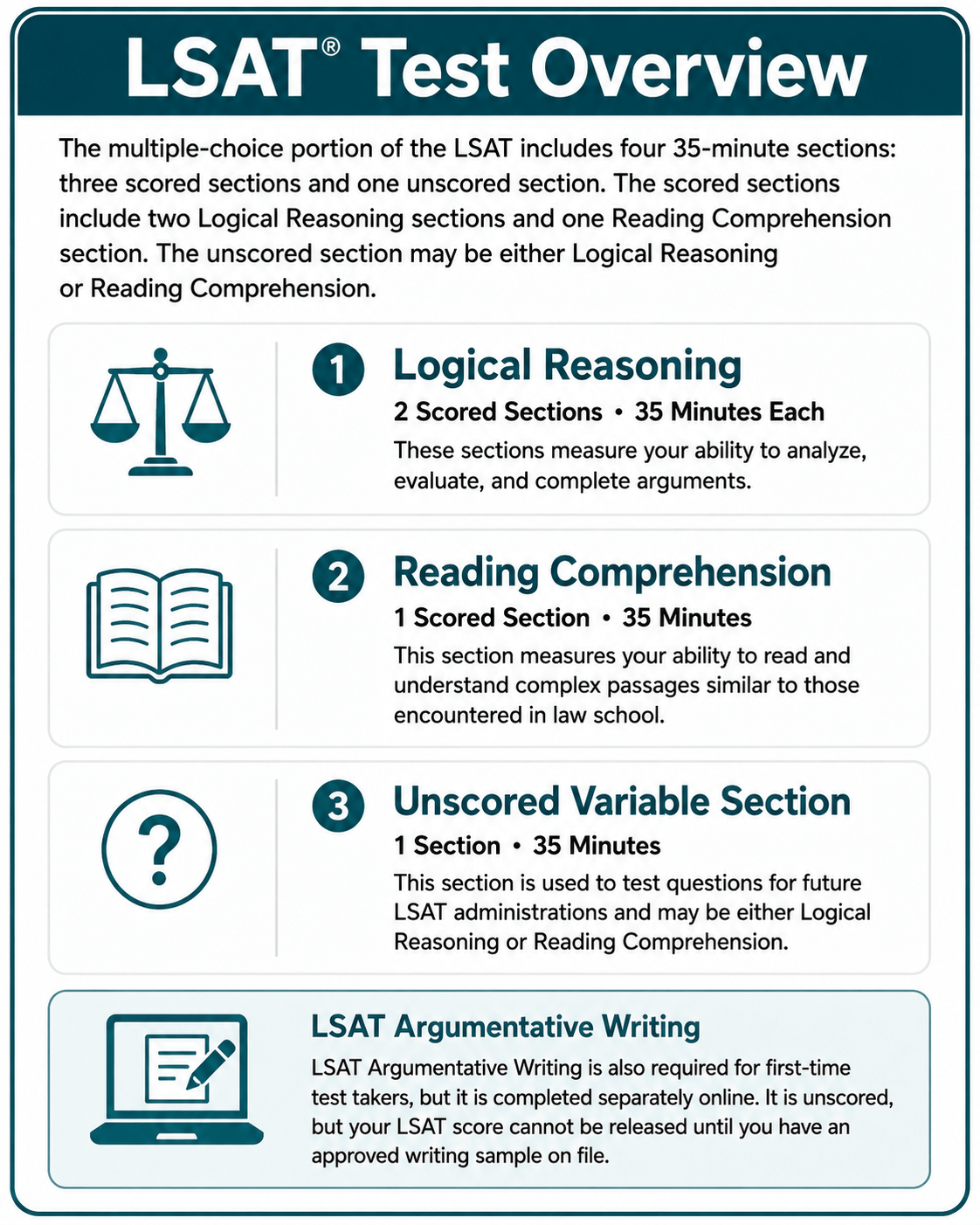
Test Overview
The standard LSAT multiple-choice test contains four 35-minute sections. Three sections are scored, and one section is unscored. The unscored section may be either Logical Reasoning or Reading Comprehension and can appear at any point in the multiple-choice test.
LSAT Sample Practice Questions
Try these LSAT-style sample questions. The multiple-choice examples focus on Logical Reasoning and Reading Comprehension, and the writing prompt reflects the current LSAT Argumentative Writing format.
1. Logical Reasoning: Strengthen the Argument
City officials installed brighter streetlights in the downtown district last year. Since then, nighttime pedestrian accidents in the district have decreased by 30 percent. Therefore, the new streetlights caused the decrease in nighttime pedestrian accidents.
Which one of the following, if true, most strengthens the argument?
- Several other districts installed brighter streetlights during the same year.
- The number of nighttime pedestrians in the downtown district was about the same before and after the new streetlights were installed.
- Most downtown businesses close before midnight.
- Some residents complained that the new streetlights were too bright.
- Daytime pedestrian accidents in the downtown district also decreased slightly.
Show Answer and Explanation
Answer: B. The number of nighttime pedestrians in the downtown district was about the same before and after the new streetlights were installed.
The argument claims that the new lights caused the decrease in accidents. Choice B rules out one alternative explanation: that fewer accidents occurred simply because fewer pedestrians were present at night.
2. Logical Reasoning: Necessary Assumption
A museum director concludes that extending the museum’s Friday evening hours will increase total weekly attendance. The director bases this conclusion on a survey of current members in which most respondents said they would visit more often if the museum stayed open later on Fridays.
Which one of the following is an assumption required by the director’s argument?
- The museum’s current members visit more often than nonmembers do.
- The museum will not need to hire any additional staff to remain open later on Fridays.
- The additional Friday visits by current members would not simply replace visits those members would otherwise make on other days.
- The museum’s exhibits are more popular on Fridays than on any other day of the week.
- The survey was conducted during a week when the museum had a special exhibit.
Show Answer and Explanation
Answer: C. The additional Friday visits by current members would not simply replace visits those members would otherwise make on other days.
The conclusion is about total weekly attendance. If Friday evening visits merely replaced visits that would have happened on other days, total attendance would not increase. The argument depends on this not happening.
3. Logical Reasoning: Identify the Flaw
All first-year law students at Eastwood University who joined the debate club reported improved public-speaking confidence by the end of the semester. Therefore, joining the debate club causes first-year law students to become more confident public speakers.
The reasoning in the argument is most vulnerable to criticism because it fails to consider that
- some law students may prefer written advocacy to oral advocacy.
- the students who joined the debate club may already have been especially motivated to improve their public-speaking skills.
- debate clubs usually require members to attend meetings regularly.
- public-speaking confidence is not the only skill needed for success in law school.
- some students at Eastwood University are not first-year law students.
Show Answer and Explanation
Answer: B. The students who joined the debate club may already have been especially motivated to improve their public-speaking skills.
The argument assumes that the club caused the improvement. Choice B points out a selection issue: the students who chose to join may have differed from other students in a way that explains the improvement.
4. Reading Comprehension: Main Point
Peer review is often described as a safeguard against error in academic research, but that description can be misleading if it suggests that peer-reviewed work is automatically correct. Reviewers may miss weaknesses in a study’s design, overlook statistical problems, or disagree about how much evidence is enough. Still, peer review remains valuable: it can force authors to clarify claims, address objections, and improve the transparency of their methods before publication.
Which one of the following best states the main point of the passage?
- Peer review is unreliable and should no longer be used in academic research.
- Peer-reviewed research is always more accurate than research that has not been peer reviewed.
- Peer review does not guarantee correctness, but it can improve research by subjecting it to critical evaluation.
- Academic reviewers usually agree about whether evidence is sufficient.
- Statistical problems are the most common weakness in academic research.
Show Answer and Explanation
Answer: C. Peer review does not guarantee correctness, but it can improve research by subjecting it to critical evaluation.
The passage criticizes an overly strong view of peer review but still defends peer review as useful. Choice C captures both parts of the author’s position.
5. Reading Comprehension: Comparative Passage
Passage A
Municipal open-data portals are valuable because they allow journalists, researchers, and residents to examine government decisions independently. When budget data, inspection records, and public-service statistics are easy to access, people outside government can identify patterns that officials may have overlooked.
Passage B
Open-data initiatives are often praised as a form of transparency, but data access alone is not enough. If datasets are incomplete, poorly labeled, or difficult to interpret, only organizations with significant technical expertise may be able to use them effectively.
Both passages most strongly support which one of the following statements?
- Open-data portals should be replaced by private research firms.
- Municipal data is useful only when it concerns budget decisions.
- Public access to government data can affect how people outside government understand public decisions.
- Only journalists should be allowed to use public-service statistics.
- Government officials rarely overlook important patterns in public records.
Show Answer and Explanation
Answer: C. Public access to government data can affect how people outside government understand public decisions.
Passage A emphasizes the benefits of public access to data, while Passage B emphasizes limitations of access alone. Both passages assume that government data can shape public understanding when people outside government use it.
6. LSAT Argumentative Writing: Sample Prompt
A state university is deciding whether to require all undergraduate students to complete at least one course in artificial intelligence and society. Read the perspectives below and write an argumentative essay in which you take a position. Your response should address at least one of the perspectives and support your position with reasons and examples.
Perspective 1: Because AI tools increasingly affect hiring, education, healthcare, and law, all students should learn how these systems influence society.
Perspective 2: A universal requirement would take time away from courses more directly related to each student’s major and career goals.
Perspective 3: Instead of requiring one AI course for everyone, universities should let departments decide whether AI instruction is relevant to their students.
Show Response Guidance
There is no single correct answer.
A strong response should take a clear position, engage with at least one perspective, use relevant reasons and examples, and organize the argument clearly. You may agree with one perspective, combine ideas from more than one perspective, or argue for a different position.
How Is the LSAT Scored?
Your LSAT score is based on the number of questions you answer correctly on the scored multiple-choice sections. All scored questions are weighted equally, and there is no deduction for incorrect answers.
LSAT Score Basics
- Score scale: 120 to 180
- Scored multiple-choice sections: two Logical Reasoning sections and one Reading Comprehension section
- Unscored section: one variable section that may be Logical Reasoning or Reading Comprehension
- LSAT Argumentative Writing: unscored, but required for first-time test takers before score release
- No penalty: there is no deduction for incorrect answers
Registration, Costs, and Testing Options
You can register for the LSAT through your LSAC account. During registration, you will choose an available administration and follow LSAC instructions for scheduling your multiple-choice test appointment.
The LSAT registration fee is currently $253 for the August 2026–June 2027 testing year. Additional fees may apply for Credential Assembly Service, score preview, score audit, test-date changes, law school reports, or other LSAC services.
Beginning with the August 2026 LSAT, most test takers will take the multiple-choice LSAT at a Prometric test center. Remote testing is limited to approved exceptions. LSAT Argumentative Writing remains separately administered in a remote, on-demand format.
Before You Register
- Create or log in to your LSAC account.
- Check law school application deadlines before choosing a test date.
- Review the current LSAT fee schedule.
- Confirm whether you need testing accommodations.
- Review current test center and remote-testing rules.
- Plan to complete LSAT Argumentative Writing early so your score release is not delayed.
Retaking the LSAT
LSAC limits how many times you may take the LSAT. Current rules allow no more than five attempts within the current reportable score period and no more than seven attempts over a lifetime.
Canceled scores count toward these numerical limits, while absences and withdrawals do not. Before retaking the exam, review your previous preparation and focus on the question types that caused the most difficulty.
How Can I Prepare for the LSAT?
Preparing for the LSAT requires more than memorizing facts. The exam measures how carefully you read, how accurately you evaluate arguments, and how well you recognize relationships between claims, evidence, and conclusions.
LSAT Study Checklist
- Review the current LSAT format before you study.
- Practice Logical Reasoning questions that ask about conclusions, assumptions, flaws, strengthening, weakening, inference, and argument structure.
- Practice Reading Comprehension passages with main point, inference, author attitude, organization, and comparative-reading questions.
- Review wrong answers carefully and identify the specific reasoning trap.
- Practice under timed 35-minute section conditions.
- Use official LSAT practice tests whenever possible.
- Practice LSAT Argumentative Writing with a timer: 15 minutes for prewriting and 35 minutes for writing.
- Build endurance by completing full practice tests under realistic conditions.
LSAT Study Resources
Top Study Guides:
Best Online Course:
High-Quality Flashcards:
Free Practice Resource:
LSAT® is a registered trademark of the Law School Admission Council, Inc. LSAC is not affiliated with StudyGuideZone or Mometrix, and LSAC does not endorse this page or any products or services mentioned on this page.