A college search is easier when you know what matters to you and compare schools using the same criteria. Start with a broad list, research academic fit and cost, check student outcomes, and narrow your choices as you learn more.
Start With Your Priorities
Before opening a college search tool, make a short list of the factors that matter most to you. You do not need to know exactly what you want yet. The goal is to identify a few priorities that can guide your first search.
Academic Fit
Majors, degree options, curriculum, class sizes, academic support, and opportunities related to your interests.
Cost
Net price, grants, scholarships, housing, transportation, expected borrowing, and other expenses.
Location
Distance from home, climate, transportation, urban or rural setting, and nearby opportunities.
Admissions Fit
Academic profile, prerequisite courses, application requirements, and the competitiveness of admission.
Outcomes
Graduation, retention, student debt, career preparation, and earnings information where available.
Personal Fit
Campus culture, housing, activities, athletics, support services, student organizations, and overall environment.
Start Broad, Then Narrow Your Search
You do not need to fill in every field on a college search tool. Too many filters can eliminate schools that might otherwise be a good fit.
- Begin with two or three important criteria, such as location, degree type, major, or school size.
- Review the schools that appear and note any that interest you.
- Add another filter if the list is too large.
- Remove a filter if the search becomes too restrictive.
- Research promising schools individually instead of relying only on search results.
A search tool should help you discover colleges, not make the final decision for you.
Be Flexible When Searching for a Major
Colleges may use different names for similar academic programs. Searching for one exact major can cause you to miss schools with closely related programs.
For example, a student interested in journalism might also search for:
- Communication
- Mass communication
- Media studies
- Digital media
- Broadcast journalism
Once you find a possible school, look at the department itself. Review the required courses, available concentrations, faculty, internships, research opportunities, and career preparation rather than relying only on the name of the major.
Compare Cost Carefully
Published tuition is only one part of college cost. Two colleges with very different sticker prices may become much closer in price after grants and scholarships are considered.
When comparing schools, look at:
- Published tuition and required fees
- Estimated net price after grants and scholarships
- Housing and meal costs
- Books, supplies, and equipment
- Transportation and travel expenses
- Average student borrowing
- Scholarship renewal requirements
- How many years students typically take to complete the program
Use the Net Price Calculator
Colleges provide net price calculators that can help families estimate what a student might pay after grants and scholarships. The result is only an estimate, but it is usually more useful for comparison than tuition alone.
Do not remove a college from your list solely because its published tuition looks high. Compare estimated net cost before deciding whether the school is financially realistic.
Use Admissions Data as a Guide
Admissions information can help you estimate how competitive a college may be, but it should not become the only factor in your search.
Depending on what a college reports and considers, useful information may include:
- High school GPA
- Course requirements
- SAT or ACT score ranges when applicable
- Acceptance rate
- Application deadlines
- Required essays or recommendations
- Portfolio, audition, or program-specific requirements
If a college otherwise looks like a strong fit, check the school’s current admissions requirements directly before eliminating it based on one search filter.
Look Beyond Getting Accepted
Admission is only the beginning. A useful college search also asks what happens after students enroll.
Retention
How many first-year students return for another year?
Graduation
How many students complete their programs, and how long does completion usually take?
Debt
How much do students typically borrow, and what might repayment look like?
Career Preparation
Are internships, clinical experiences, career services, networking, and employer connections available?
Check Accreditation and Program Requirements
Accreditation should be part of your research, especially if you expect to use federal financial aid, transfer credits, attend graduate school, or enter a licensed profession.
Verify the college’s institutional accreditation rather than relying only on advertising language.
Some academic programs also have specialized or programmatic accreditation. This can be particularly important in fields such as:
- Nursing and other health professions
- Teaching and education
- Counseling
- Engineering
- Architecture
- Law
- Other professions that require licensure or certification
If your intended career requires a professional license, verify that the specific program meets the education requirements for the state where you expect to work.
Think About Location and Daily Life
Location affects more than how often you can go home. It can influence your total cost, transportation, internship opportunities, housing options, and everyday experience.
Consider:
- Travel time and transportation options
- Urban, suburban, or rural setting
- On-campus and off-campus housing
- Access to internships and employers
- Climate
- Campus safety information
- Availability of health, counseling, tutoring, and disability services
- Student organizations, recreation, athletics, and campus events
Visit Your Finalists
Online research can narrow your list, but a campus visit can reveal things that statistics and photographs cannot.
During a visit, try to go beyond the standard admissions tour. When possible:
- Visit while classes are in session.
- Talk with current students.
- Visit the department for your intended major.
- See classrooms, residence halls, dining areas, and study spaces.
- Ask about tutoring and academic support.
- Ask about internships and career services.
- Ask students what they like and dislike about the school.
- Take notes immediately afterward so different campuses do not blend together.
Build a Balanced College List
Your final application list should not consist entirely of schools with the same level of admissions competitiveness.
More Competitive
Schools where admission may be less predictable based on your academic profile and the institution’s admissions data.
Similar Profile
Schools where your academic profile appears similar to that of many recently admitted students.
More Likely
Schools where your profile suggests a stronger likelihood of admission and that you would genuinely be happy to attend.
A school is not a useful backup option unless it is academically appropriate, financially realistic, and somewhere you would actually consider attending.
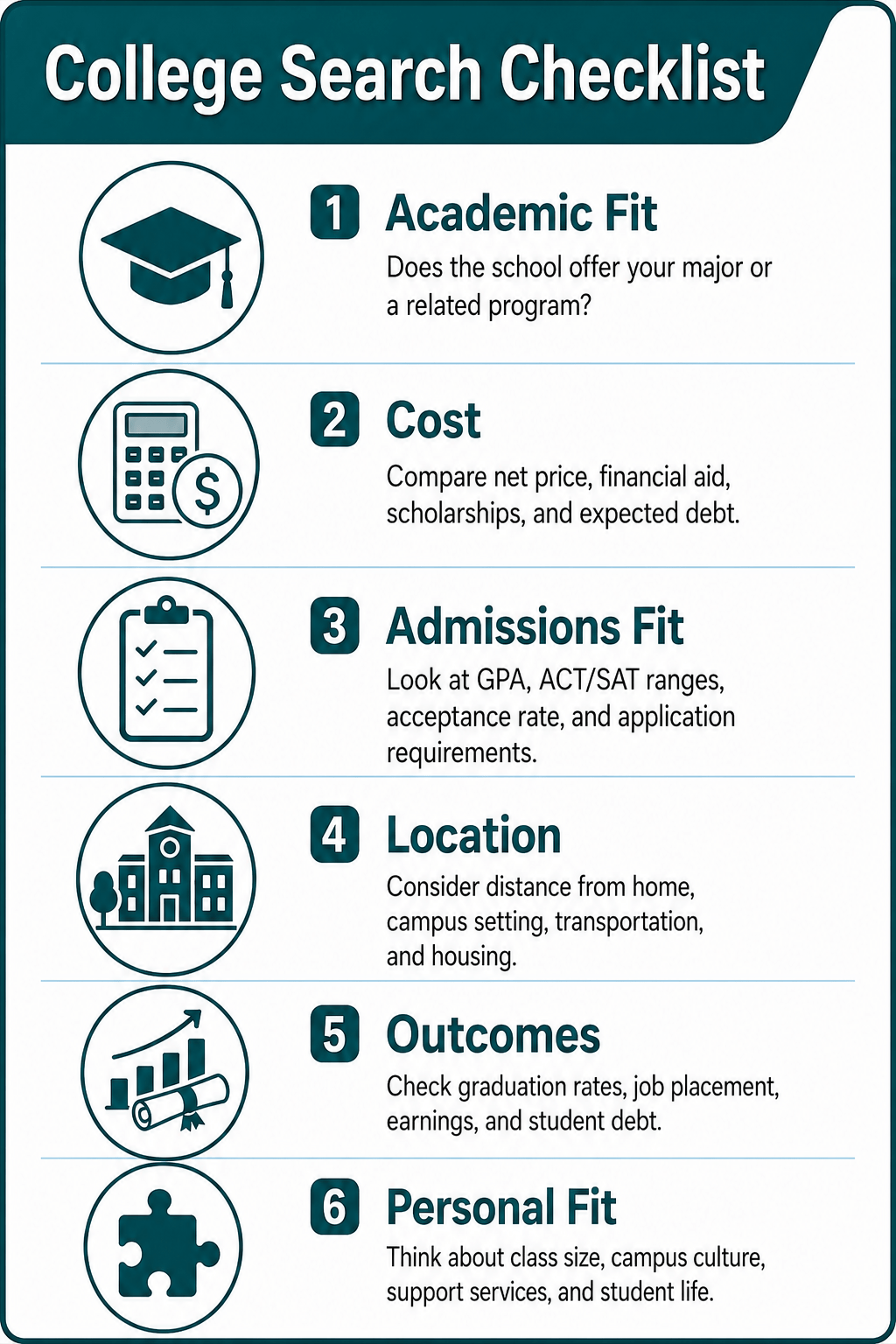
College Search Checklist
Use these six questions when comparing schools so that every college is being judged on roughly the same factors.
Useful College Search Tools
No single website contains everything you need. Compare information from several sources and verify important details on the college’s own website.
College Scorecard
Compare colleges by fields of study, costs, admissions information, graduation outcomes, debt, and earnings information.
College Navigator
Search colleges by location, major, degree level, school type, tuition, enrollment, housing, and campus setting.
Accreditation Database
Verify whether an institution or program is reported as accredited by an accrediting agency recognized by the U.S. Department of Education.