This overview includes information to help you prepare for the ATI TEAS® exam. You’ll find details about the exam format, section timing, registration, costs, scoring, retakes, study resources, and sample practice questions.
Exam TypeNursing and allied health admissions exam | Main SectionsReading, Mathematics, Science, and English and Language Usage |
Total Items170 total items, including scored and unscored items | Time Limit209 minutes |
Exam Background and Purpose
The ATI TEAS exam is used by many nursing and allied health programs as part of the admissions process. The exam measures essential academic skills in reading, math, science, and English language usage.
The current ATI TEAS Version 7 includes multiple-choice questions and alternate item types, such as multiple-select, fill-in-the-blank numeric, hot spot, and ordered response questions.
Key point: TEAS score requirements are set by individual nursing and allied health programs. Always check your school’s current minimum score, retake policy, deadline, and accepted testing method before registering.
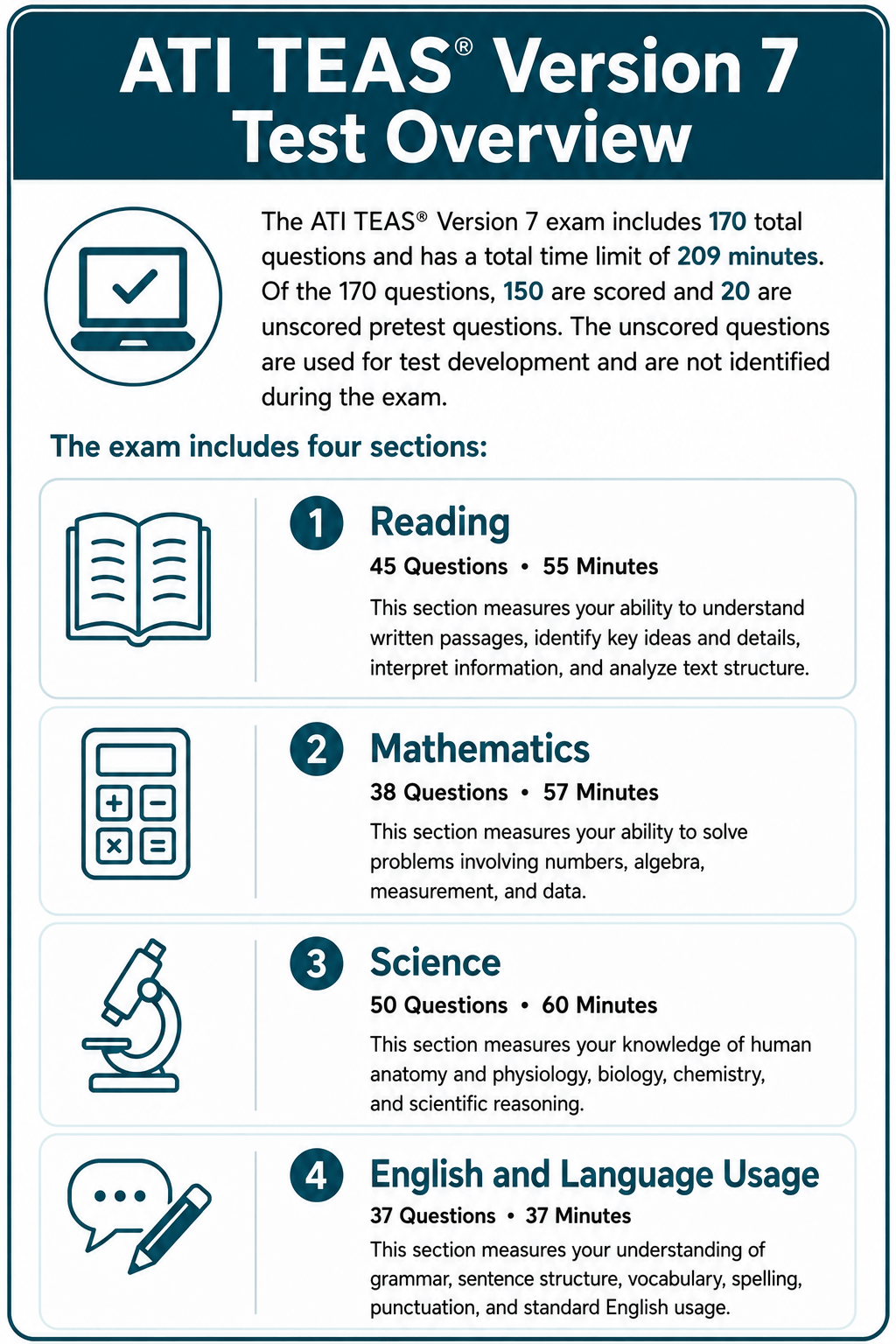
Test Overview
The ATI TEAS Version 7 is divided into four timed content areas. The exam includes 150 scored items and 20 unscored pretest items, for 170 total items.
Start ATI TEAS Prep with Mometrix
ATI TEAS Sample Practice Questions
Try these original ATI TEAS-style sample questions. These examples reflect common TEAS content areas and item formats, but they are not actual ATI exam questions.
1. Reading: Key Ideas and Details
A nurse educator reviews patient instructions and notices that many patients are missing follow-up appointments. The educator revises the instructions by using shorter sentences, adding appointment reminders, and placing the most important information at the beginning of the handout. After the revision, more patients attend their follow-up visits.
Which statement best summarizes the passage?
- Patients usually miss appointments because they do not read written instructions.
- Shorter patient instructions can replace the need for follow-up appointments.
- Clearer written instructions may help patients understand and follow care directions.
- Nurse educators should avoid using appointment reminders in written materials.
Show Answer and Explanation
Answer: C. Clearer written instructions may help patients understand and follow care directions.
The passage explains that improving the handout was followed by better follow-up attendance. Choice C captures the main idea without overstating the cause.
2. Reading: Ordered Response
Place the sentences in the most logical order to form a clear paragraph.
- Finally, the sample is labeled and sent to the laboratory.
- Before collecting the sample, the nurse verifies the patient’s identity.
- The nurse then explains the procedure and gathers the necessary supplies.
- After collection, the nurse checks that the container is properly sealed.
Show Answer and Explanation
Correct order: B, C, D, A
The process begins with verifying identity, then explaining the procedure and gathering supplies. After collection, the nurse checks the container, labels it, and sends it to the lab.
3. Mathematics: Fill-in-the-Blank Numeric
A patient is prescribed 250 mg of a medication. The medication is available as 125 mg per tablet. How many tablets should the patient receive?
Enter your answer: ______ tablets
Show Answer and Explanation
Answer: 2
Divide the prescribed dose by the dose per tablet: 250 ÷ 125 = 2 tablets.
4. Mathematics: Measurement and Data
A clinic recorded the number of patients seen each morning for five days: 18, 21, 20, 23, and 18. What was the mean number of patients seen each morning?
- 18
- 20
- 21
- 22
Show Answer and Explanation
Answer: B. 20
Add the values: 18 + 21 + 20 + 23 + 18 = 100. Divide by 5 days: 100 ÷ 5 = 20.
5. Science: Multiple Select
Which structures are part of the respiratory system? Select all that apply.
- Trachea
- Alveoli
- Esophagus
- Bronchi
- Small intestine
- Diaphragm
Show Answer and Explanation
Answers: A, B, D, and F
The trachea, alveoli, bronchi, and diaphragm are involved in breathing and gas exchange. The esophagus and small intestine are part of the digestive system.
6. Science: Hot Spot-Style Item
The simplified diagram below represents the path of air through the respiratory system. Select the area where gas exchange primarily occurs.
| A Nasal cavity | B Trachea |
| C Bronchi | D Alveoli |
- Nasal cavity
- Trachea
- Bronchi
- Alveoli
Show Answer and Explanation
Answer: D. Alveoli
Gas exchange occurs primarily in the alveoli, where oxygen diffuses into the blood and carbon dioxide diffuses out of the blood.
7. Science: Scientific Reasoning
A student tests whether fertilizer affects plant growth. Twenty identical plants are divided into two groups. Group 1 receives water only. Group 2 receives the same amount of water plus fertilizer. After four weeks, the student compares plant height.
Which group is the control group?
- Group 1, because it receives water only
- Group 2, because it receives fertilizer
- Both groups, because they contain the same number of plants
- Neither group, because the experiment uses living organisms
Show Answer and Explanation
Answer: A. Group 1, because it receives water only
The control group does not receive the experimental treatment. Group 1 is used for comparison because it does not receive fertilizer.
8. English and Language Usage: Standard English Conventions
Which sentence is written correctly?
- The nurse reviewed the chart, and explains the procedure.
- The nurse reviews the chart, and explained the procedure.
- The nurse reviewed the chart and explained the procedure.
- The nurse reviewing the chart and explained the procedure.
Show Answer and Explanation
Answer: C. The nurse reviewed the chart and explained the procedure.
Choice C uses consistent past-tense verbs and forms a complete sentence. The other choices have verb-tense or sentence-structure problems.
How Is the ATI TEAS Scored?
Your ATI TEAS score report includes an overall score and section scores. Programs may use the overall score, section scores, or both when making admissions decisions.
There is no single national passing score for the ATI TEAS. Each nursing or allied health program decides what score is required or competitive for admission.
ATI TEAS Score Basics
- Overall score: combines performance across the exam
- Section scores: Reading, Math, Science, and English and Language Usage
- Score use: set by each school or program
- Score report: may include topic-level feedback for review
- Passing requirements: vary by program
Registration, Costs, and Testing Options
You can register for the ATI TEAS through ATI, PSI, or through a school or testing center, depending on the testing method your program accepts. Some schools require TEAS at ATI, some use PSI, and others administer the exam directly through the institution.
ATI lists TEAS at ATI and TEAS at PSI exams at $120. Additional proctoring, scheduling, room, remote monitoring, or institutional fees may apply depending on the testing situation.
Before You Register
- Confirm which TEAS testing method your program accepts.
- Check your school’s minimum score and deadline.
- Review current fees before scheduling.
- Confirm whether your exam is in person, remotely proctored, or administered by your school.
- Check ID requirements before test day.
- Review calculator, scratch paper, and personal-item rules for your testing method.
- Ask your program how it handles TEAS transcripts and score submission.
Retaking the ATI TEAS
Retake rules can depend on the testing method and the school or program using your score. ATI lists a 14-day wait period between TEAS at ATI attempts, but schools may also set their own retake limits, waiting periods, or application-cycle rules.
Before retaking the TEAS, review your score report and focus your study plan on the content areas and subtopics where your score was weakest.
How Can I Prepare for the ATI TEAS?
Preparing for the ATI TEAS is easier when you study by section and practice the current item types. Review core content, then complete timed practice questions so you can build speed, accuracy, and comfort with the format.
ATI TEAS Study Checklist
- Review the current ATI TEAS Version 7 structure before you study.
- Practice reading for main ideas, details, inferences, vocabulary, and text structure.
- Review arithmetic, percentages, ratios, proportions, equations, measurement, and data interpretation.
- Study human anatomy and physiology, biology, chemistry, scientific reasoning, and basic physical science.
- Review grammar, punctuation, sentence structure, word meaning, and clear written communication.
- Practice alternate item types, including multiple-select, numeric fill-in, ordered response, and hot spot questions.
- Use timed practice sets so the section pacing feels familiar.
- Review missed questions and identify whether the error was content, reading, setup, calculation, or grammar.
ATI TEAS Study Resources
Best Online Course:
Top Study Guides:
High-Quality Flashcards:
Free Practice Resource:
Start ATI TEAS Prep with Mometrix
ATI TEAS® is a registered trademark of Assessment Technologies Institute, LLC. Assessment Technologies Institute is not affiliated with StudyGuideZone or Mometrix, and it does not endorse this page or any products or services mentioned on this page.