This overview includes information to help you prepare for the HSPT® exam. You’ll find details about the test format, content areas, registration, scoring, test-day rules, study resources, and sample practice questions.
Test TypeHigh school placement and admissions assessment | Administered ByIndividual schools, dioceses, or school systems |
Total Questions298 multiple-choice questions | Main SectionsVerbal, quantitative, reading, math, and language |
Exam Background and Purpose
The High School Placement Test, or HSPT, is commonly used by Catholic and other private high schools to evaluate students entering ninth grade. Schools may consider HSPT scores when making admissions decisions, placing students into courses, identifying areas for remediation, or awarding scholarships.
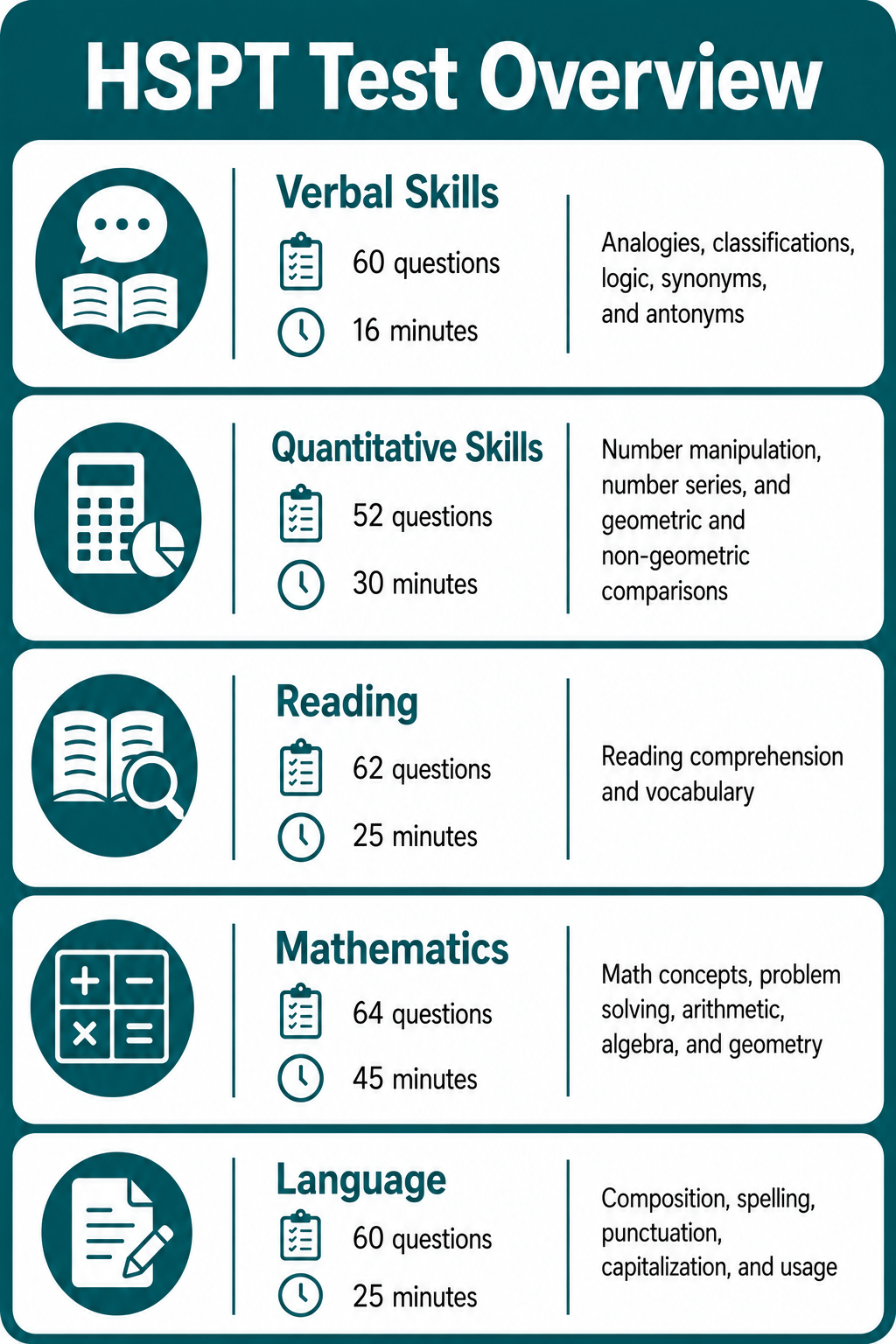
The standard HSPT includes five multiple-choice subtests: Verbal Skills, Quantitative Skills, Reading, Mathematics, and Language. These subtests measure a mix of reasoning ability and learned academic skills.
Key point: there is no universal “passing score” for the HSPT. Each school decides how it uses scores for admission, placement, scholarships, or course recommendations.
Online HSPT Prep Course
If you want structured review, Mometrix offers an online HSPT Prep Course. The course includes review lessons, practice questions, flashcards, instructional videos, progress tracking, and study tools designed to help you review the skills tested on the HSPT.
Course Features
- 70 HSPT lessons
- 1,790+ HSPT practice questions
- 330+ digital flashcards
- 240+ review videos
- Progress tracking
- Bonus tools and test-taking tips
What Is on the HSPT?
The HSPT is divided into five main content areas. Each section measures a different set of academic or reasoning skills that schools can use for placement and admissions decisions.
HSPT Sample Practice Questions
Try these original HSPT-style sample questions. These examples reflect common Verbal Skills, Quantitative Skills, Reading, Mathematics, and Language question types, but they are not actual STS exam questions.
1. Verbal Skills: Synonym
Choose the word that is closest in meaning to RESOLUTE.
- uncertain
- determined
- careless
- ordinary
Show Answer and Explanation
Answer: B. determined
Resolute means firm, decided, or determined.
2. Verbal Skills: Analogy
Painter is to brush as writer is to:
- book
- pen
- library
- chapter
Show Answer and Explanation
Answer: B. pen
A painter uses a brush. In the same relationship, a writer uses a pen.
3. Verbal Skills: Classification
Which word does not belong with the others?
- oak
- maple
- pine
- rose
Show Answer and Explanation
Answer: D. rose
Oak, maple, and pine are trees. A rose is a flowering shrub.
4. Quantitative Skills: Number Series
Look at the pattern below.
2, 6, 12, 20, 30, ___
Which number comes next?
- 36
- 40
- 41
- 42
Show Answer and Explanation
Answer: D. 42
The differences are 4, 6, 8, and 10. The next difference is 12, so 30 + 12 = 42.
5. Quantitative Skills: Quantitative Comparison
Compare the two quantities.
Quantity A 3/5 of 45 | Quantity B 30% of 100 |
- Quantity A is greater.
- Quantity B is greater.
- The two quantities are equal.
- The relationship cannot be determined from the information given.
Show Answer and Explanation
Answer: B. Quantity B is greater.
3/5 of 45 is 27. 30% of 100 is 30. Since 30 is greater than 27, Quantity B is greater.
6. Reading: Main Idea
Read the passage.
In many cities, community gardens are built on vacant lots. These gardens can provide fresh vegetables, give neighbors a place to work together, and create green space in crowded areas. Although a garden cannot solve every problem in a neighborhood, it can become a useful part of community improvement.
Which sentence best states the main idea of the passage?
- Community gardens are useful only for growing vegetables.
- Vacant lots should never be changed.
- Community gardens can benefit neighborhoods in several ways.
- Neighborhood problems can be solved only by building parks.
Show Answer and Explanation
Answer: C. Community gardens can benefit neighborhoods in several ways.
The passage lists multiple benefits of community gardens, including fresh vegetables, cooperation, and green space.
7. Reading: Vocabulary in Context
In the passage from Question 6, the word vacant most nearly means:
- empty
- crowded
- dangerous
- colorful
Show Answer and Explanation
Answer: A. empty
A vacant lot is an empty or unused lot.
8. Mathematics: Algebra
Solve for x:
3x + 4 = 22
- 4
- 5
- 6
- 8
Show Answer and Explanation
Answer: C. 6
Subtract 4 from both sides to get 3x = 18. Divide by 3 to get x = 6.
9. Mathematics: Geometry
A rectangle has a length of 14 inches and a width of 6 inches. What is its area?
- 20 square inches
- 40 square inches
- 84 square inches
- 168 square inches
Show Answer and Explanation
Answer: C. 84 square inches
The area of a rectangle is length times width. Multiply 14 by 6 to get 84 square inches.
10. Language: Sentence Correction
Choose the sentence that is written correctly.
- The students finished the assignment, and turned it in before lunch.
- The students finished the assignment and turned it in before lunch.
- The students finished the assignment turned it in before lunch.
- The students finished, the assignment and turned it in before lunch.
Show Answer and Explanation
Answer: B. The students finished the assignment and turned it in before lunch.
Choice B is clear and correctly punctuated. Choice A uses an unnecessary comma between compound verbs, and choices C and D contain sentence or punctuation errors.
HSPT Registration
HSPT registration is handled by the school, diocese, or school system administering the exam. There is not one universal national registration process for every student.
Contact the school where you plan to apply for details about registration deadlines, test dates, fees, arrival time, required materials, and testing policies.
HSPT Cost
The cost of taking the HSPT varies by school or testing program. Some schools include the exam as part of the application process, while others charge a separate testing fee. Check directly with the school for the exact cost and payment instructions.
Testing Accommodations
The HSPT is school-administered, so schools are responsible for reviewing and approving testing accommodation requests. If you need accommodations, contact the school administering the exam as early as possible.
Students who need large-print materials or another approved format should ask the school about availability, documentation, and request deadlines before test day.
What to Expect on Test Day
Test-day rules are set by the school administering the exam, so review the instructions provided by your school before test day. The HSPT itself remains a paper-format test. Students mark answers on a separate answer sheet, though some programs may use an online answer sheet for scoring.
In general, students should arrive on time, bring any required materials, and follow the school’s testing-room instructions. Under standardized conditions, calculators are not used for the Quantitative Skills or Mathematics subtests.
Test-Day Checklist
- Confirm your test date, arrival time, and location with the school.
- Bring any identification or admission materials required by the school.
- Bring approved pencils or other materials if instructed.
- Do not use a calculator unless your school has specifically approved one as an accommodation.
- Follow the proctor’s instructions for the test booklet and answer sheet.
- Work only in the section currently being administered.
- Answer every question if time allows, since incorrect answers do not reduce your score.
Breaks During the HSPT
Break policies vary by school or testing program. Some schools may include short breaks between sections or groups of sections, while others may use a different schedule.
If you have a medical or disability-related need for breaks, ask the school about its accommodation process before the test date.
HSPT Scoring
Students receive one raw-score point for each correct answer. Points are not deducted for incorrect answers, so there is no penalty for guessing. Raw scores are converted into standard scores and other reported score types.
HSPT score reports may include several types of scores, such as raw scores, standard scores, percentile ranks, stanines, cognitive skills scores, basic skills scores, grade equivalents, and a battery composite score.
Score Report Terms
- Raw score: the number of questions answered correctly.
- Standard score: a converted score often reported on a 200–800 scale.
- Percentile rank: a comparison of the student’s performance with a national or local sample.
- Stanine: a nine-point score category.
- Total Cognitive Skills: based on Verbal Skills and Quantitative Skills.
- Total Basic Skills: based on Reading, Mathematics, and Language.
- Battery Composite: overall performance on the five core subtests.
What Is a Good HSPT Score?
There is no single passing score for the HSPT. Each school decides how it will use scores for admission, placement, scholarship decisions, or academic planning.
In general, stronger scores and higher percentile ranks can help in competitive admissions or scholarship consideration, but the score each school looks for can vary. The best approach is to ask the school where you plan to apply how it reviews and uses HSPT results.
Can You Retake the HSPT?
HSPT retake policies vary by school, diocese, and testing program. Some schools may not recommend or allow students to retest during the same admissions cycle, and others may only consider or report one score.
Before registering for another test date, contact the school directly to confirm its policy.
How Can I Prepare for the HSPT?
Start by becoming familiar with the five main HSPT sections: Verbal Skills, Quantitative Skills, Reading, Mathematics, and Language. Then use practice questions to identify the areas where you need the most review.
Because the HSPT is a timed exam, pacing is just as important as content knowledge. The Verbal Skills and Reading sections in particular can feel fast, so practice moving steadily and making educated guesses when needed.
For the best preparation, use a combination of review lessons, practice questions, flashcards, and full-length practice tests. This approach helps you strengthen the skills tested on the exam while also becoming more comfortable with the test format.
HSPT Study Checklist
- Review synonyms, antonyms, analogies, classifications, and logical reasoning.
- Practice number series, number manipulation, and quantitative comparison questions.
- Read short passages and answer questions about main idea, details, inference, purpose, and vocabulary in context.
- Review arithmetic, fractions, decimals, percentages, measurement, geometry, algebra, and statistics.
- Practice grammar, punctuation, capitalization, spelling, usage, and composition questions.
- Use timed practice so you can build speed without losing accuracy.
- Review missed questions by identifying the specific skill that caused the error.
- Ask the school whether it uses optional Science or Catholic Religion testing.
HSPT Study Resources
Best Online Course:
Top Study Guide:
High-Quality Flashcards:
Free Practice Resource:
HSPT® is a registered trademark of Scholastic Testing Service, Inc. StudyGuideZone and Mometrix are not affiliated with or endorsed by Scholastic Testing Service, Inc. or any official HSPT testing authority.