This overview includes information to help you prepare for the NCLEX-RN® exam. You’ll find details about eligibility, registration, testing format, costs, scoring, retakes, study resources, and sample practice questions.
Exam TypeRegistered nurse licensure exam | FormatComputerized adaptive test with Next Generation NCLEX item types |
Exam Length85 to 150 items | Time Limit5 hours, including breaks |
Exam Background and Purpose
The NCLEX-RN® exam is used by nursing regulatory bodies to help determine whether a candidate is ready for entry-level registered nursing practice. The exam measures nursing knowledge, clinical judgment, safety, prioritization, client care, and the ability to make decisions in realistic care situations.
The NCLEX-RN is administered by computerized adaptive testing. This means the exam adjusts as you answer questions, and each candidate receives an exam that fits the NCLEX-RN test plan while measuring whether the candidate meets the passing standard.
Key point: the NCLEX-RN includes traditional item types and Next Generation NCLEX clinical judgment item types, including case-study items that ask you to recognize cues, analyze cues, prioritize hypotheses, generate solutions, take action, and evaluate outcomes.
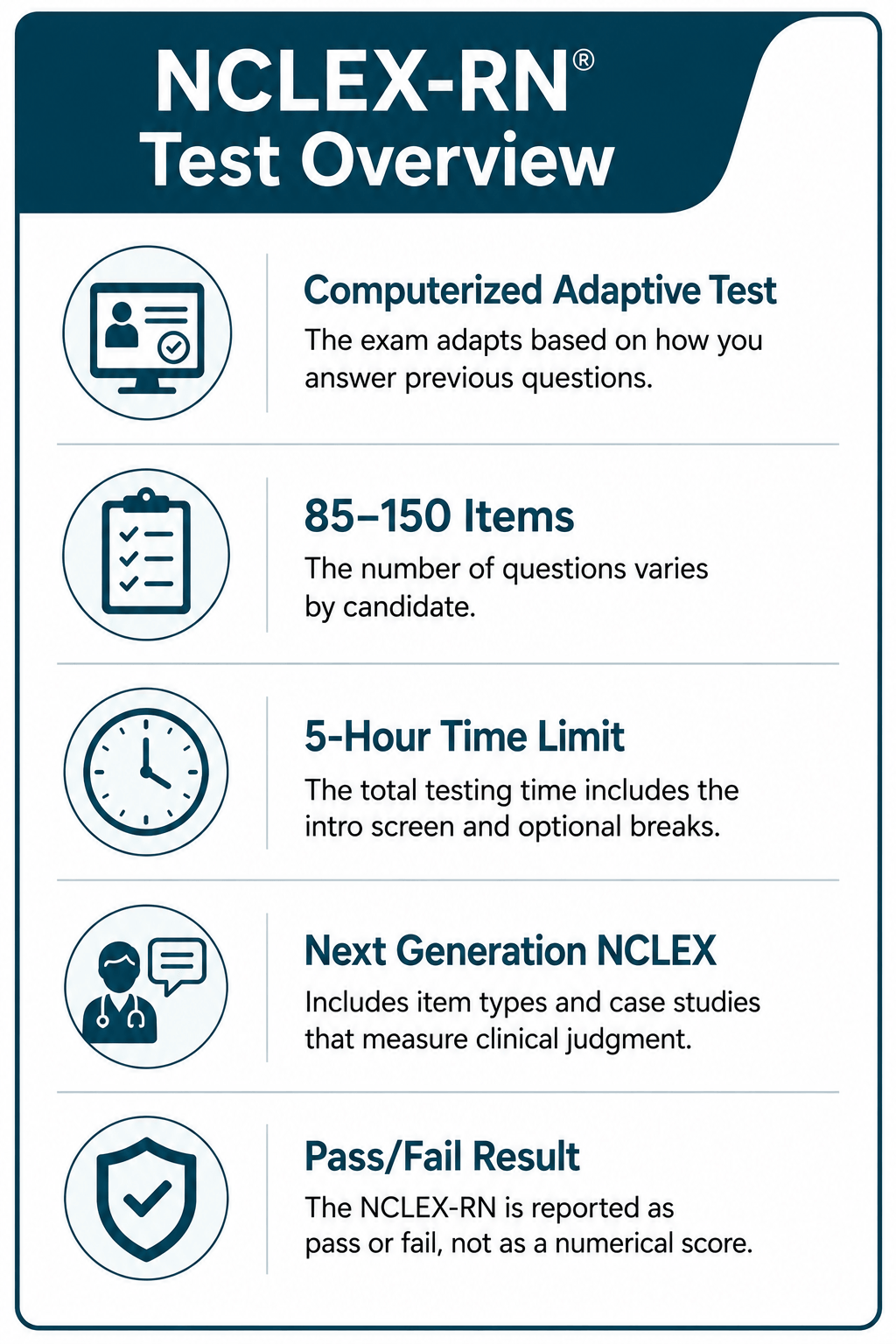
Test Overview
The NCLEX-RN exam can include multiple-choice questions, multiple-response questions, ordered-response questions, fill-in-the-blank calculations, exhibit items, and Next Generation NCLEX item types such as matrix/grid, cloze, extended multiple response, and extended drag-and-drop.
Start NCLEX-RN Prep with Mometrix
NCLEX-RN Sample Practice Questions
Try these original NCLEX-RN-style sample questions. These examples include traditional and Next Generation NCLEX-style formats; they are not actual NCSBN exam questions.
1. Multiple Choice: Prioritization
The nurse is caring for four clients. Which client should the nurse assess first?
- A client 2 days after abdominal surgery who reports incisional pain rated 6 out of 10
- A client with asthma who has audible wheezing and an oxygen saturation of 89%
- A client with type 2 diabetes who has a blood glucose level of 72 mg/dL and is eating breakfast
- A client with a urinary tract infection who has a temperature of 100.8°F (38.2°C)
Show Answer and Explanation
Answer: B. A client with asthma who has audible wheezing and an oxygen saturation of 89%
Airway and breathing problems take priority. Wheezing with low oxygen saturation indicates respiratory compromise and requires immediate assessment.
2. Multiple Response: Select All That Apply
The nurse is caring for a client with suspected active pulmonary tuberculosis. Which actions should the nurse take? Select all that apply.
- Place the client in a negative-pressure room.
- Wear a surgical mask when providing direct care.
- Wear an N95 respirator before entering the room.
- Keep the room door closed.
- Use droplet precautions as the primary isolation category.
- Have the client wear a surgical mask during necessary transport.
Show Answer and Explanation
Answers: A, C, D, and F
Active pulmonary tuberculosis requires airborne precautions. The client should be placed in a negative-pressure room, staff should wear an N95 respirator, the door should remain closed, and the client should wear a surgical mask if transport is necessary.
3. Cloze-Style Clinical Judgment
A client with diabetes is awake, alert, diaphoretic, and reports feeling shaky. The client’s blood glucose is 52 mg/dL.
Complete the sentence by choosing the best options.
The client is most likely experiencing ______.
Options: hyperglycemia / hypoglycemia / ketoacidosis / fluid volume overload
The priority nursing action is to ______.
Options: give 15 g of fast-acting carbohydrate / administer long-acting insulin / restrict oral intake / place the client in Trendelenburg position
Show Answer and Explanation
Answers: hypoglycemia; give 15 g of fast-acting carbohydrate
A blood glucose of 52 mg/dL with shakiness and diaphoresis is consistent with hypoglycemia. Because the client is awake and able to swallow, the nurse should give a fast-acting carbohydrate and then reassess blood glucose.
4. Matrix/Grid: Recognize Cues
A client with preeclampsia is receiving magnesium sulfate by continuous IV infusion. For each finding, indicate whether the finding requires immediate follow-up.
| Finding | Requires Immediate Follow-Up | Does Not Require Immediate Follow-Up |
|---|---|---|
| Respiratory rate 10/min | A | B |
| Absent deep tendon reflexes | A | B |
| Urine output 20 mL/hr | A | B |
| Flushing and warmth | A | B |
Show Answer and Explanation
Answers: Requires follow-up, requires follow-up, requires follow-up, does not require immediate follow-up
Respiratory depression, absent reflexes, and low urine output can indicate magnesium toxicity or impaired magnesium excretion and require immediate follow-up. Flushing and warmth can occur with magnesium sulfate and are not the priority finding in this scenario.
5. Ordered Response: Emergency Care
The nurse finds an adult client unresponsive, not breathing normally, and without a pulse. Place the actions in the order the nurse should perform them.
- Start chest compressions.
- Activate the emergency response system and obtain an AED.
- Resume chest compressions immediately after shock delivery or if no shock is advised.
- Apply the AED pads and follow the AED prompts.
Show Answer and Explanation
Correct order: B, A, D, C
The nurse should first activate emergency help and obtain an AED, then begin chest compressions. Once the AED is available, the nurse applies the pads and follows the prompts, then resumes compressions immediately after shock delivery or if no shock is advised.
6. Bow-Tie-Style Clinical Judgment
A client has had vomiting and diarrhea for 24 hours. Assessment findings include heart rate 118/min, blood pressure 88/54 mm Hg, dry mucous membranes, capillary refill 4 seconds, and urine output 15 mL/hr.
Complete the clinical judgment diagram by identifying the most likely condition, two actions, and two parameters to monitor.
| Most Likely Condition | Actions to Take | Parameters to Monitor |
|---|---|---|
A. Fluid volume deficit B. Fluid volume excess C. Hyperglycemia | A. Initiate prescribed isotonic IV fluids. B. Restrict oral and IV fluids. C. Place the client flat with legs elevated if tolerated. D. Administer a loop diuretic as the priority action. | A. Blood pressure B. Urine output C. Visual acuity D. Pupil size |
Show Answer and Explanation
Answers: Fluid volume deficit; initiate prescribed isotonic IV fluids and place the client flat with legs elevated if tolerated; monitor blood pressure and urine output
Vomiting, diarrhea, hypotension, tachycardia, delayed capillary refill, dry mucous membranes, and low urine output support fluid volume deficit. Priority care focuses on restoring circulating volume and monitoring perfusion indicators.
How Is the NCLEX-RN Scored?
The NCLEX-RN is reported as pass or fail. The exam uses computerized adaptive testing to estimate whether your ability is above or below the passing standard. The number of questions you receive does not by itself tell you whether you passed or failed.
NCLEX-RN Score Basics
- Result format: pass or fail
- Minimum items: 85
- Maximum items: 150
- Time limit: 5 hours, including breaks
- Exam length: determined by computerized adaptive testing and the candidate’s response pattern
- Official results: provided through the nursing regulatory body
Registration, Costs, and Testing Options
Before registering for the NCLEX-RN, you must apply for licensure or registration through the nursing regulatory body where you want to be licensed. After you register and the nursing regulatory body determines that you are eligible, you will receive an Authorization to Test, commonly called an ATT.
The NCLEX registration fee for candidates seeking U.S. licensure is $200. Additional fees may apply for international scheduling, changing the nursing regulatory body, changing the exam type, or meeting state-specific licensure requirements.
Before You Register
- Apply to the nursing regulatory body where you want to be licensed.
- Confirm that you meet all state or jurisdiction eligibility requirements.
- Register for the NCLEX through the official NCLEX registration process.
- Wait for your Authorization to Test before scheduling your exam appointment.
- Review the current candidate bulletin before test day.
- Make sure your identification matches your registration information.
Retaking the NCLEX-RN
If you do not pass the NCLEX-RN, your nursing regulatory body will provide information about retesting. Retake rules can vary by jurisdiction, but candidates generally must wait before scheduling another attempt.
Before retesting, review your Candidate Performance Report, focus on weak content areas, and practice clinical judgment questions that require prioritization, cue recognition, and outcome evaluation.
How Can I Prepare for the NCLEX-RN Exam?
Preparing for the NCLEX-RN is easier when you practice the way the exam asks you to think. Review core nursing content, but also practice applying that content to clinical scenarios, identifying the most important cues, choosing safe interventions, and evaluating whether care was effective.
NCLEX-RN Study Checklist
- Review the current NCLEX-RN test plan before you study.
- Practice prioritization, delegation, safety, infection control, and medication questions.
- Review physiological adaptation, pharmacology, psychosocial integrity, and health promotion concepts.
- Practice Next Generation NCLEX item types, including matrix, cloze, extended multiple response, and case-study items.
- Use the nursing process and clinical judgment steps when reviewing rationales.
- Review missed questions and identify whether the error involved content, prioritization, safety, or clinical judgment.
- Take timed practice sets so the exam pace feels familiar.
NCLEX-RN Study Resources
Best Online Course:
Top Study Guides:
High-Quality Flashcards:
Free Practice Resource:
Start NCLEX-RN Prep with Mometrix
NCLEX-RN® and NCLEX® are registered trademarks of the National Council of State Boards of Nursing, Inc. NCSBN is not affiliated with StudyGuideZone or Mometrix, and NCSBN does not endorse this page or any products or services mentioned on this page.