This overview includes information to help you prepare for the GRE® General Test. You’ll find details about the exam format, registration, testing options, costs, scoring, retakes, study resources, and sample practice questions.
Exam TypeGraduate admissions exam | Main SectionsAnalytical Writing, Verbal Reasoning, and Quantitative Reasoning |
Total Test TimeAbout 1 hour and 58 minutes | Score ReportingSeparate Verbal, Quantitative, and Analytical Writing scores |
Exam Background and Purpose
The GRE® General Test is used by many graduate, business, and law programs as part of the admissions process. The exam measures verbal reasoning, quantitative reasoning, critical thinking, and analytical writing skills that are important for graduate-level academic work.
The current GRE General Test is shorter than older versions of the exam. It includes one Analytical Writing task, two Verbal Reasoning sections, and two Quantitative Reasoning sections.
Key point: the current GRE General Test begins with Analytical Writing. The Verbal Reasoning and Quantitative Reasoning sections may appear in either order after that.
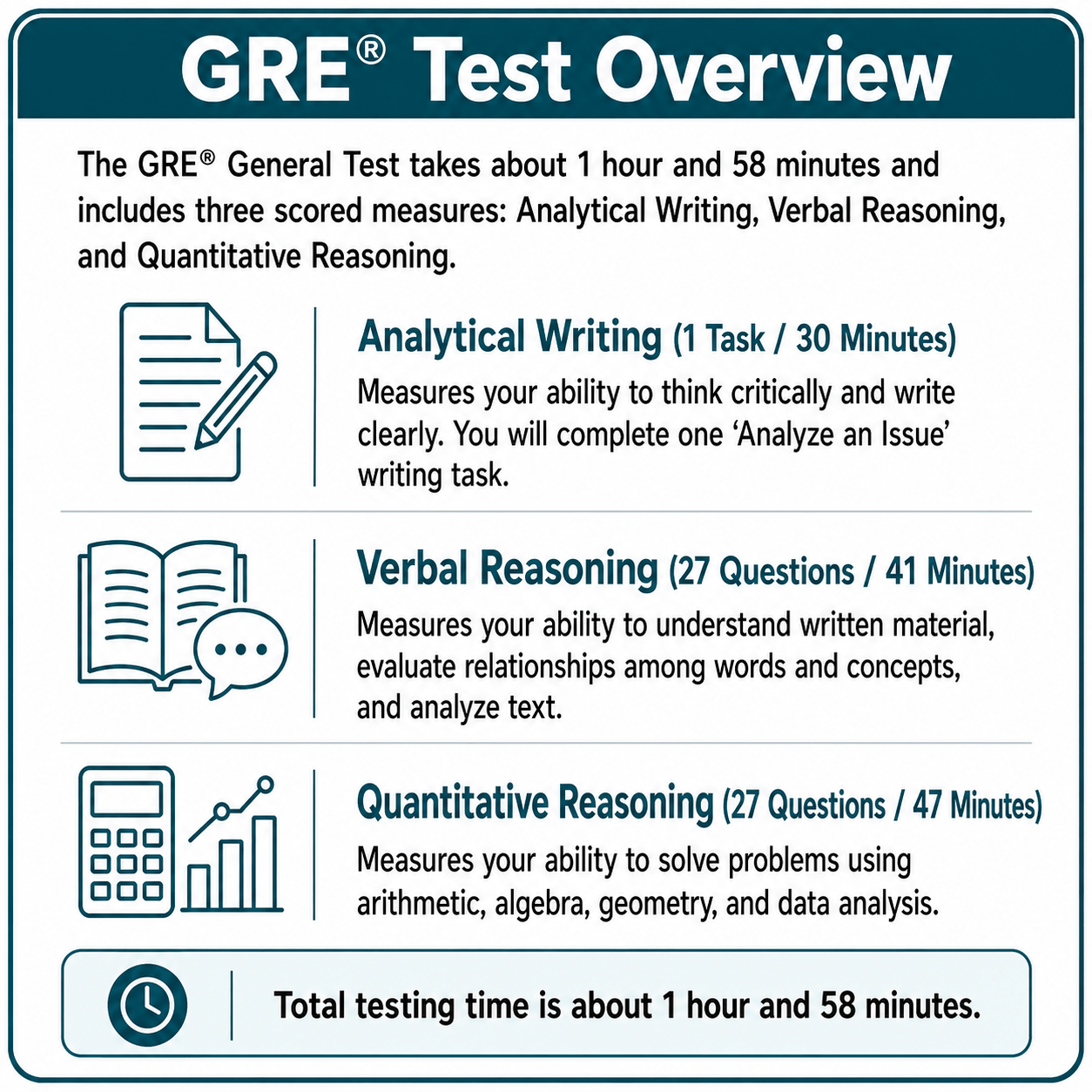
Test Overview
The GRE General Test has five sections. The Analytical Writing section is always first. After that, the two Verbal Reasoning sections and two Quantitative Reasoning sections may appear in different orders.
GRE Sample Practice Questions
Try these sample questions to review GRE-style formats. These examples include Text Completion, Sentence Equivalence, Reading Comprehension, Quantitative Comparison, Numeric Entry, and an Analyze an Issue writing prompt.
1. Verbal Reasoning: Text Completion
Because the preliminary results were ______, the researchers repeated the experiment before publishing their conclusions.
- definitive
- equivocal
- irrelevant
- excessive
- unprecedented
Show Answer and Explanation
Answer: B. equivocal
The researchers repeated the experiment before publishing, which suggests that the preliminary results were uncertain or open to more than one interpretation. Equivocal means ambiguous or unclear.
2. Verbal Reasoning: Sentence Equivalence
Select the two answer choices that complete the sentence and produce sentences that are alike in meaning.
After weeks of disagreement among its members, the committee issued a final recommendation that was unexpectedly ______.
- divisive
- unanimous
- fragmented
- unified
- tentative
- controversial
Show Answer and Explanation
Answers: B. unanimous and D. unified
The phrase after weeks of disagreement sets up a contrast. A recommendation that is unanimous or unified would be unexpected after disagreement, and the two completed sentences are similar in meaning.
3. Verbal Reasoning: Reading Comprehension
For decades, some urban planners assumed that widening roads would reduce traffic congestion. Recent studies, however, suggest that added road capacity can encourage additional driving. As a result, traffic levels may eventually return to what they were before the roads were widened.
Which choice best expresses the main idea of the passage?
- Urban planners have stopped using traffic studies when designing roads.
- Widening roads may not reduce congestion over the long term because it can lead to more driving.
- Recent studies show that narrow roads are always safer than wide roads.
- Traffic congestion is caused only by poor road design.
- Drivers prefer older roads because they are more familiar.
Show Answer and Explanation
Answer: B. Widening roads may not reduce congestion over the long term because it can lead to more driving.
The passage contrasts an old assumption with recent studies. Its main point is that increased road capacity can encourage more driving, which may prevent long-term reductions in congestion.
4. Quantitative Reasoning: Quantitative Comparison
n is an integer greater than 1.
| Quantity A | Quantity B |
|---|---|
| n2 – n | n |
- Quantity A is greater.
- Quantity B is greater.
- The two quantities are equal.
- The relationship cannot be determined from the information given.
Show Answer and Explanation
Answer: D. The relationship cannot be determined from the information given.
If n = 2, Quantity A is 22 – 2 = 2, which equals Quantity B. If n = 3, Quantity A is 32 – 3 = 6, which is greater than Quantity B. Since different valid values of n give different relationships, the relationship cannot be determined.
5. Quantitative Reasoning: Numeric Entry
The average of five numbers is 18. Four of the numbers are 12, 16, 20, and 22. What is the fifth number?
Enter your answer: ______
Show Answer and Explanation
Answer: 20
If the average of five numbers is 18, their total is 5 × 18 = 90. The four known numbers total 12 + 16 + 20 + 22 = 70. The fifth number is 90 – 70 = 20.
6. Analytical Writing: Analyze an Issue
Some people believe that universities should require all students to take courses outside their major field of study. Others believe students should focus only on courses directly related to their chosen field.
Write a response in which you discuss the extent to which you agree or disagree with requiring students to take courses outside their major. Support your position with reasons and examples.
Show Response Guidance
There is no single correct answer.
A strong response should take a clear position, address the complexity of the issue, use relevant reasons and examples, and maintain a focused, organized argument. You may agree, disagree, or take a qualified position.
How Is the GRE Scored?
The GRE General Test reports separate scores for Verbal Reasoning, Quantitative Reasoning, and Analytical Writing. Verbal and Quantitative scores are each reported on a 130–170 scale, while Analytical Writing is reported on a 0–6 scale.
GRE Score Basics
- Verbal Reasoning: 130 to 170, in 1-point increments
- Quantitative Reasoning: 130 to 170, in 1-point increments
- Analytical Writing: 0 to 6, in half-point increments
- Official scores are usually available in your ETS account 8–10 days after your test date.
- GRE scores are reportable for five years after your test date.
Registration, Costs, and Testing Options
You can register for the GRE General Test through your ETS account. Testing is available at test centers and at home in many locations, but appointment availability, identification rules, and testing options can vary by country or region.
ETS lists the GRE General Test fee at $220 for most areas of the world, with a scheduled increase to $249 for registrations completed on or after August 1, 2026. Additional fees may apply for rescheduling, changing a test center, ordering additional score reports, score reinstatement, or Analytical Writing score review.
Before You Register
- Create or log in to your ETS account.
- Confirm whether your program requires or accepts GRE scores.
- Check application deadlines before choosing a test date.
- Review current test fees and rescheduling rules.
- Confirm the ID requirements for your testing location.
- Choose whether to test at a test center or at home, if both options are available to you.
Retaking the GRE
You may retake the GRE General Test, but there are limits. ETS allows test takers to take the GRE General Test once every 21 days, up to five times within any continuous rolling 12-month period.
This limit applies even if you canceled your scores from a previous test. Before retesting, review your score report and focus your study plan on the question types or skills that caused the most difficulty.
How Can I Prepare for the GRE?
Preparing for the GRE is easier when you study by question type. Verbal Reasoning practice should include Reading Comprehension, Text Completion, and Sentence Equivalence. Quantitative Reasoning practice should include arithmetic, algebra, geometry, data analysis, quantitative comparison, and numeric entry. Analytical Writing practice should focus on building a clear argument under a 30-minute time limit.
GRE Study Checklist
- Review the current GRE section structure before you study.
- Practice Text Completion and Sentence Equivalence questions using context clues and word relationships.
- Read short and medium-length passages and practice identifying main ideas, evidence, structure, and inference.
- Review arithmetic, algebra, geometry, and data analysis.
- Practice Quantitative Comparison questions carefully; do not assume a relationship from only one example.
- Practice Numeric Entry questions without relying on answer choices.
- Write timed Analyze an Issue essays using clear claims, reasons, and examples.
- Review missed questions and identify the reasoning error behind each mistake.
GRE Study Resources
Top Study Guides:
Best Online Course:
High-Quality Flashcards:
Free Practice Resource:
GRE® is a registered trademark of Educational Testing Service (ETS). ETS is not affiliated with StudyGuideZone or Mometrix, and ETS does not endorse this page or any products or services mentioned on this page.