This overview includes information to help you prepare for the GMAT™ exam. You’ll find details about the exam format, registration, testing options, scoring, retakes, study resources, and sample practice questions.
Exam TypeGraduate business school admissions exam | Main SectionsQuantitative Reasoning, Verbal Reasoning, and Data Insights |
Total Questions64 questions | Total Score205 to 805 |
Exam Background and Purpose
The GMAT™ exam is used by many graduate business schools as part of the admissions process for MBA and other graduate management programs. The exam measures problem-solving, critical reasoning, data analysis, reading comprehension, and quantitative reasoning skills.
The current GMAT exam has three sections: Quantitative Reasoning, Verbal Reasoning, and Data Insights. There is no Analytical Writing Assessment on the current version of the exam.
Key point: the GMAT is shorter than older versions of the exam. The current test has 64 total questions and takes 2 hours and 15 minutes, plus one optional 10-minute break.
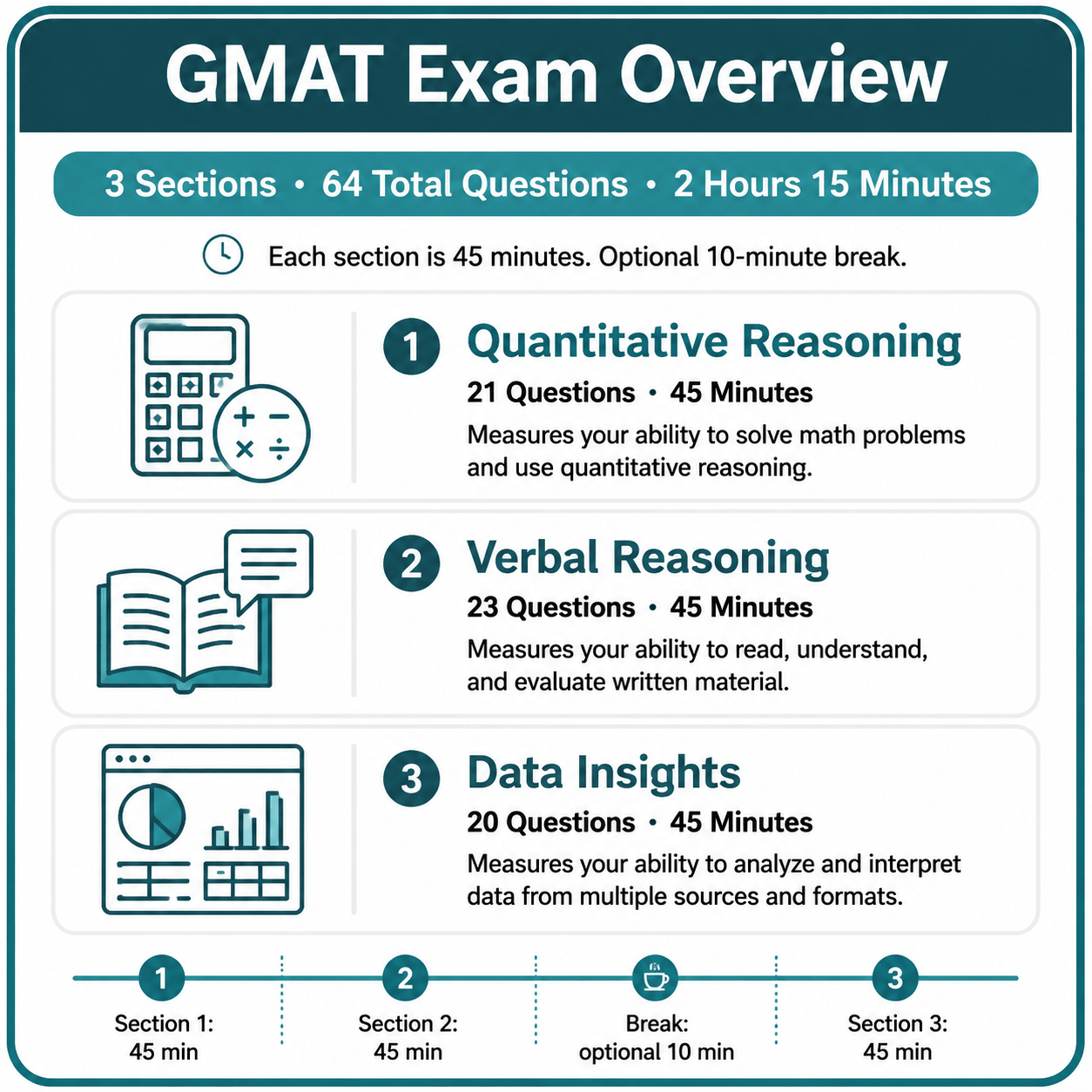
Test Overview
The GMAT exam contains three timed sections. You can choose the order in which you take the sections, and you may take one optional 10-minute break after the first or second section.
GMAT Sample Practice Questions
Try these sample questions to review the types of reasoning skills tested on the GMAT. Answer each question first, then open the explanation to check your work.
1. Quantitative Reasoning: A store buys 12 identical calculators for $180 and sells each calculator for $20. What is the total profit from selling all 12 calculators?
- $20
- $40
- $60
- $80
- $240
Show Answer and Explanation
Answer: C. $60
The store earns 12 × $20 = $240 in revenue. Profit is revenue minus cost, so $240 – $180 = $60.
2. Quantitative Reasoning: If 3x + 2y = 18 and y = 3, what is the value of x?
- 2
- 3
- 4
- 6
- 9
Show Answer and Explanation
Answer: C. 4
Substitute 3 for y: 3x + 2(3) = 18. Then 3x + 6 = 18, so 3x = 12 and x = 4.
3. Verbal Reasoning: Which choice most strengthens the argument?
A company plans to let employees work from home two days each week. Managers argue that this change will increase productivity because employees will spend less time commuting.
- Most employees at the company live within five minutes of the office.
- Employees at similar companies completed more work after switching to a hybrid schedule.
- The company recently redesigned its office lobby.
- Some employees prefer to work in the office every day.
- The company has fewer employees than it did five years ago.
Show Answer and Explanation
Answer: B. Employees at similar companies completed more work after switching to a hybrid schedule.
The argument claims that a hybrid schedule will increase productivity. Choice B provides direct supporting evidence from similar companies.
4. Verbal Reasoning: Which conclusion is best supported by the passage?
A manufacturer replaced several older machines with newer models. The newer machines use less electricity per hour, but they also require more frequent maintenance than the older machines did.
- The new machines will definitely reduce the manufacturer’s total operating costs.
- The old machines never required maintenance.
- The new machines have at least one advantage and at least one disadvantage compared with the old machines.
- The manufacturer replaced the machines only because electricity prices increased.
- The new machines produce lower-quality products than the old machines did.
Show Answer and Explanation
Answer: C. The new machines have at least one advantage and at least one disadvantage compared with the old machines.
The passage states that the new machines use less electricity, which is an advantage, but require more frequent maintenance, which is a disadvantage.
5. Data Insights: A company tracked quarterly sales for two products.
| Quarter | Product A Sales | Product B Sales | Total Marketing Cost |
|---|---|---|---|
| Q1 | $40,000 | $30,000 | $10,000 |
| Q2 | $45,000 | $35,000 | $12,000 |
| Q3 | $50,000 | $45,000 | $15,000 |
Based on the table, determine whether each statement is true.
| Statement | True | False |
|---|---|---|
| Combined sales increased each quarter. | A | B |
| Product B sales increased by more than 40% from Q1 to Q3. | A | B |
| Marketing cost was exactly 15% of combined sales in Q3. | A | B |
Show Answer and Explanation
Answers: True, True, False
Combined sales were $70,000 in Q1, $80,000 in Q2, and $95,000 in Q3, so they increased each quarter. Product B increased from $30,000 to $45,000, which is a 50% increase. In Q3, marketing cost was $15,000 out of $95,000, which is not exactly 15%.
6. Data Insights: Is x greater than 0?
Statement 1: x2 = 9
Statement 2: x3 = 27
- Statement 1 alone is sufficient, but Statement 2 alone is not sufficient.
- Statement 2 alone is sufficient, but Statement 1 alone is not sufficient.
- Both statements together are sufficient, but neither statement alone is sufficient.
- Each statement alone is sufficient.
- The two statements together are not sufficient.
Show Answer and Explanation
Answer: B. Statement 2 alone is sufficient, but Statement 1 alone is not sufficient.
Statement 1 means x could be 3 or -3, so it is not sufficient. Statement 2 means x = 3, so x is greater than 0. Statement 2 alone is sufficient.
How Is the GMAT Scored?
Your GMAT Total Score is based on your performance on all three sections: Quantitative Reasoning, Verbal Reasoning, and Data Insights. Each section contributes equally to the Total Score.
GMAT Score Basics
- Total Score: 205 to 805
- Quantitative Reasoning: 60 to 90
- Verbal Reasoning: 60 to 90
- Data Insights: 60 to 90
- Scores are valid for five years.
- Unanswered questions can hurt your score, so pacing matters.
Registration, Costs, and Testing Options
You can register for the GMAT through your mba.com account. The exam is available at test centers and online, but testing availability, rules, fees, and scheduling options can vary by location.
The GMAT registration fee depends on your location and delivery format. Additional fees may apply for rescheduling, cancellation, score services, or other changes. Review the current mba.com fee information before registering.
Retaking the GMAT
You may retake the GMAT, but there are limits. You must wait at least 16 calendar days between GMAT appointments, and online and test-center appointments count together toward the attempt limits.
You may take the GMAT up to five times within a rolling 12-month period. Canceled scores count toward that limit, but appointments canceled before the exam and missed appointments do not count.
How Can I Prepare for the GMAT?
Preparing for the GMAT is easier when you study by section and practice the kinds of reasoning the exam uses. Focus on solving problems efficiently, reading arguments carefully, interpreting data accurately, and managing time within each 45-minute section.
GMAT Study Checklist
- Review the current three-section GMAT format before you study.
- Practice Quantitative Reasoning problem-solving questions.
- Study ratios, rates, percentages, algebra, equations, and word problems.
- Practice Verbal Reasoning questions that ask you to evaluate arguments and understand passages.
- Review Data Insights question types such as Data Sufficiency, Table Analysis, Graphics Interpretation, Multi-Source Reasoning, and Two-Part Analysis.
- Practice pacing within each 45-minute section.
- Review missed questions and identify the reasoning error behind each mistake.
- Take timed practice sets so test-day pacing feels familiar.
GMAT Study Resources
Top Study Guides:
High-Quality Flashcards:
Free Practice Resource:
GMAT™ and Graduate Management Admission Test™ are trademarks of the Graduate Management Admission Council (GMAC). GMAC is not affiliated with StudyGuideZone or Mometrix, and GMAC does not endorse this page or any products or services mentioned on this page.