This overview includes information to help you prepare for the GED® test. You’ll find details about eligibility, registration, test subjects, scoring, retakes, study resources, and sample practice questions.
Exam TypeHigh school equivalency exam | Test SubjectsFour separate subject tests |
RegistrationOfficial GED account | Passing Score145 or higher on each subject |
Exam Background and Purpose
The GED® test is a high school equivalency exam for people who did not complete a traditional high school diploma. Passing the GED test can help meet education requirements for jobs, college admission, career training programs, and other opportunities that require a high school-level credential.
The GED test is divided into four separate subject exams. You do not have to take all four subjects on the same day, so many test takers schedule one subject at a time.
Key point: GED rules, fees, age requirements, and testing options can vary by state. Always check your state’s current GED rules before registering.
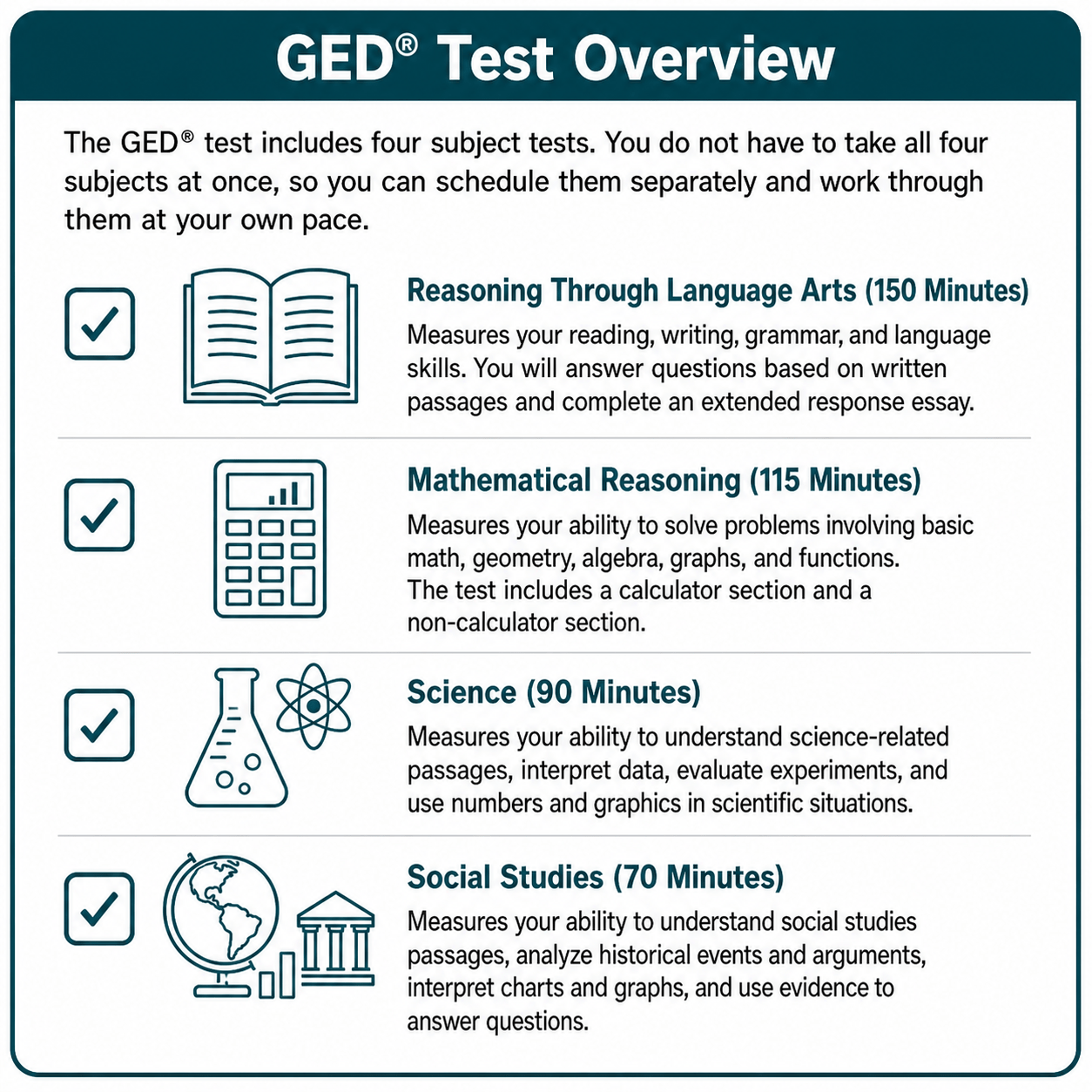
Test Overview
The GED test is made up of four subject tests. Each subject measures a different group of academic skills, and each subject receives its own score.
GED Sample Practice Questions
Try these sample questions to review the types of skills tested on the GED. Answer each question first, then open the explanation to check your work.
1. Reasoning Through Language Arts: Which choice best combines the sentences?
The city opened a new community garden. The garden gives residents a place to grow vegetables and meet their neighbors.
- The city opened a new community garden, it gives residents a place to grow vegetables and meet their neighbors.
- The city opened a new community garden that gives residents a place to grow vegetables and meet their neighbors.
- The city opened a new community garden, giving residents vegetables and neighbors.
- The city opened a new community garden because residents grow vegetables and neighbors.
Show Answer and Explanation
Answer: B. The city opened a new community garden that gives residents a place to grow vegetables and meet their neighbors.
Choice B combines the ideas clearly and correctly. Choice A creates a comma splice, and choices C and D change the meaning.
2. Mathematical Reasoning: A store sells notebooks for $3 each. If a student buys 7 notebooks and pays with a $25 bill, how much change should the student receive?
- $3
- $4
- $18
- $21
Show Answer and Explanation
Answer: B. $4
Seven notebooks cost 7 × $3 = $21. The student pays $25, so the change is $25 – $21 = $4.
3. Mathematical Reasoning: Solve for x: 4x + 6 = 30.
- 5
- 6
- 8
- 9
Show Answer and Explanation
Answer: B. 6
Subtract 6 from both sides to get 4x = 24. Divide by 4 to get x = 6.
4. Science: A student records plant height once each week.
| Week | Plant Height |
|---|---|
| 1 | 6 cm |
| 2 | 9 cm |
| 3 | 12 cm |
| 4 | 15 cm |
If the pattern continues, what should the plant height be in week 5?
- 16 cm
- 17 cm
- 18 cm
- 21 cm
Show Answer and Explanation
Answer: C. 18 cm
The plant grows 3 cm each week. After 15 cm in week 4, the next height is 18 cm.
5. Social Studies: Read the statement and answer the question.
A local government holds a public meeting before voting on a new city budget. Residents are allowed to speak and ask questions before the vote.
Which civic principle is best represented by this situation?
- Public participation in government
- Separation of powers between countries
- Trial by jury in criminal cases
- Control of prices by private businesses
Show Answer and Explanation
Answer: A. Public participation in government
The residents are taking part in a public decision-making process by speaking and asking questions before the vote.
6. Reasoning Through Language Arts: Which sentence is written correctly?
- Because the train was late the passengers waited on the platform.
- Because the train was late, the passengers waited on the platform.
- Because, the train was late the passengers waited on the platform.
- Because the train was late, and the passengers waited on the platform.
Show Answer and Explanation
Answer: B. Because the train was late, the passengers waited on the platform.
An introductory dependent clause should be followed by a comma. Choice B uses the comma correctly and forms a complete sentence.
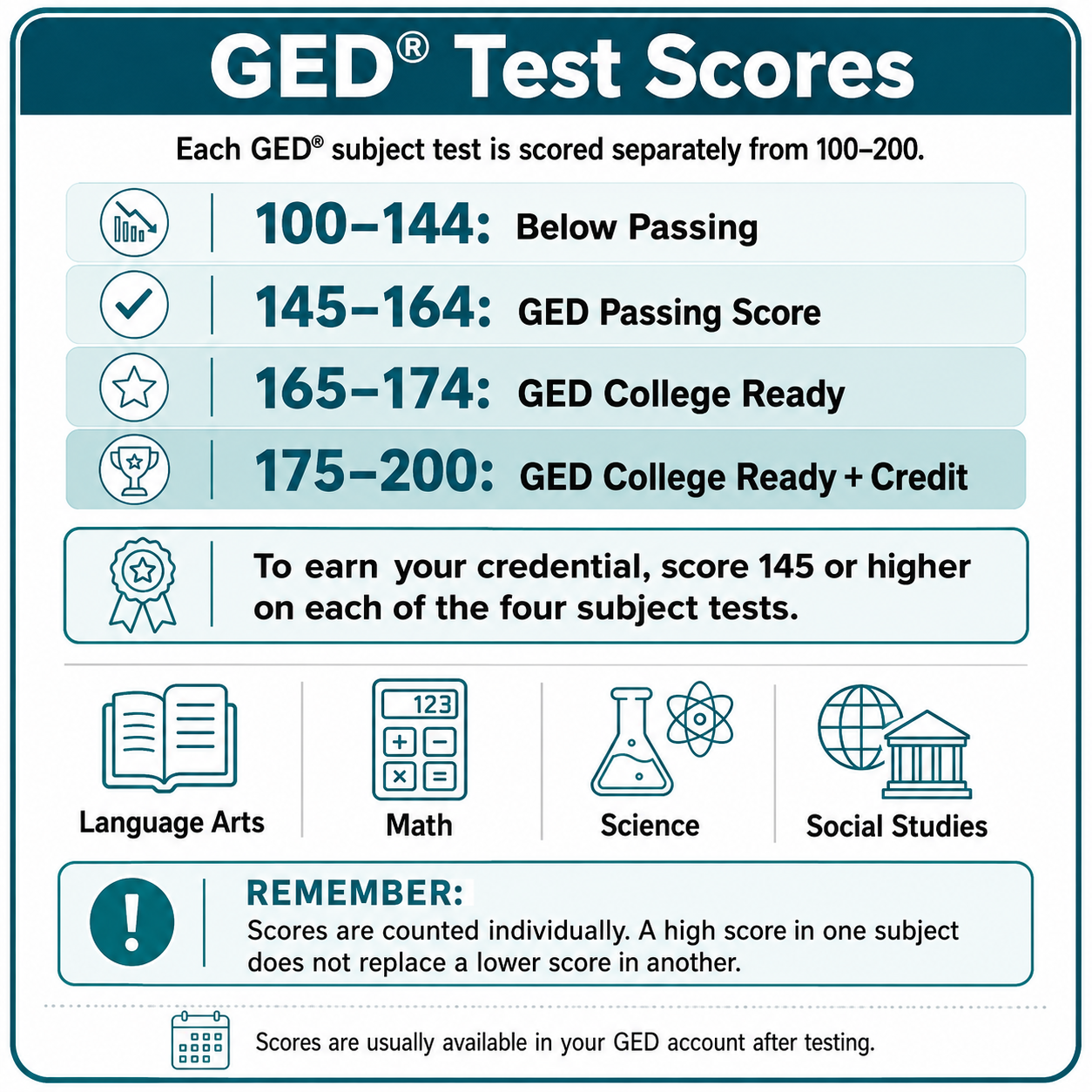
How Is the GED Scored?
Each GED subject test is scored separately. You need to score 145 or higher on each subject test to pass and earn the credential.
GED Score Ranges
- 145–164: GED Passing Score
- 165–174: GED College Ready
- 175–200: GED College Ready + Credit
Registration, Costs, and Testing Options
You can create an account through the official GED website, choose your state or testing area, and schedule the subject tests you are ready to take. Testing may be available at an approved test center, online from home, or both, depending on your location and eligibility.
The cost of the GED test varies by state. Some states charge a fee per subject test, while others may provide reduced-cost or no-cost testing through state programs, adult education programs, employers, or other assistance options.
Retaking the GED
If you do not pass a subject test, you may be able to retake that subject. Retake rules, waiting periods, and retake fees can vary by state and testing situation, so check your GED account and state rules before scheduling another attempt.
How Can I Prepare for the GED Test?
Preparing for the GED test is easier when you study one subject at a time and practice the types of questions you will see on the exam. Focus on the areas where your skills are weakest, then use practice questions to check your progress.
GED Study Checklist
- Review the four GED subject tests and decide which subject to study first.
- Practice reading passages and identifying main ideas, details, and arguments.
- Review grammar, sentence structure, and extended response writing.
- Study basic math, algebra, geometry, graphs, and word problems.
- Practice interpreting science experiments, charts, and data tables.
- Review social studies passages, historical arguments, maps, graphs, and civic concepts.
- Take timed practice questions so the pace feels familiar before test day.
- Review missed questions carefully and write down what caused each mistake.
GED Study Resources
Top Study Guides:
Best Online Course:
High-Quality Flashcards:
Free Practice Resources:
GED® is a registered trademark of GED Testing Service LLC. GED Testing Service LLC is not affiliated with StudyGuideZone or Mometrix, and it does not endorse this page or any products or services mentioned on this page.