This overview includes information to help you prepare for an esthetician licensing exam. You’ll find details about common exam formats, content areas, registration, scoring, retakes, test-day rules, study resources, and sample practice questions.
Test TypeState esthetician licensing exam | Common Exam ProviderNIC or another state-approved testing vendor |
Common Exam PartsTheory, practical, written practical, or state law | Main FocusSafety, infection control, skin science, and skin-care services |
Exam Background and Purpose
State licensing boards use esthetician exams to determine whether candidates have the knowledge and practical skills needed to provide safe skin-care services. These exams commonly test infection control, skin structure and function, skin conditions, client consultation, facial procedures, hair removal, makeup, body treatments, product safety, and professional procedures.
There is no single esthetician exam that applies in every state. Many jurisdictions use examinations developed by the National-Interstate Council of State Boards of Cosmetology, commonly called NIC, while other states may use a different testing vendor or state-specific exam. Always check your state board or testing provider for the exact testing rules, application process, fees, score requirements, and retake policy.
Key point: esthetician licensing exams are heavily safety-based. Infection control, sanitation, disinfection, client protection, contraindications, and proper service procedures should be treated as high-priority study areas.
Online Esthetician Prep Course
If you want structured review, Mometrix offers an online Esthetician Prep Course. The course includes study lessons, practice questions, flashcards, progress tracking, mobile access, and study tools designed to help you review the topics tested on esthetician licensing exams.
Course Features
- 40+ Esthetician study lessons
- 330 Esthetician practice questions
- 250+ digital flashcards
- Progress tracking
- Mobile access
- 7-day money-back guarantee
Start Esthetician Prep with Mometrix
What Is on the Esthetician Exam?
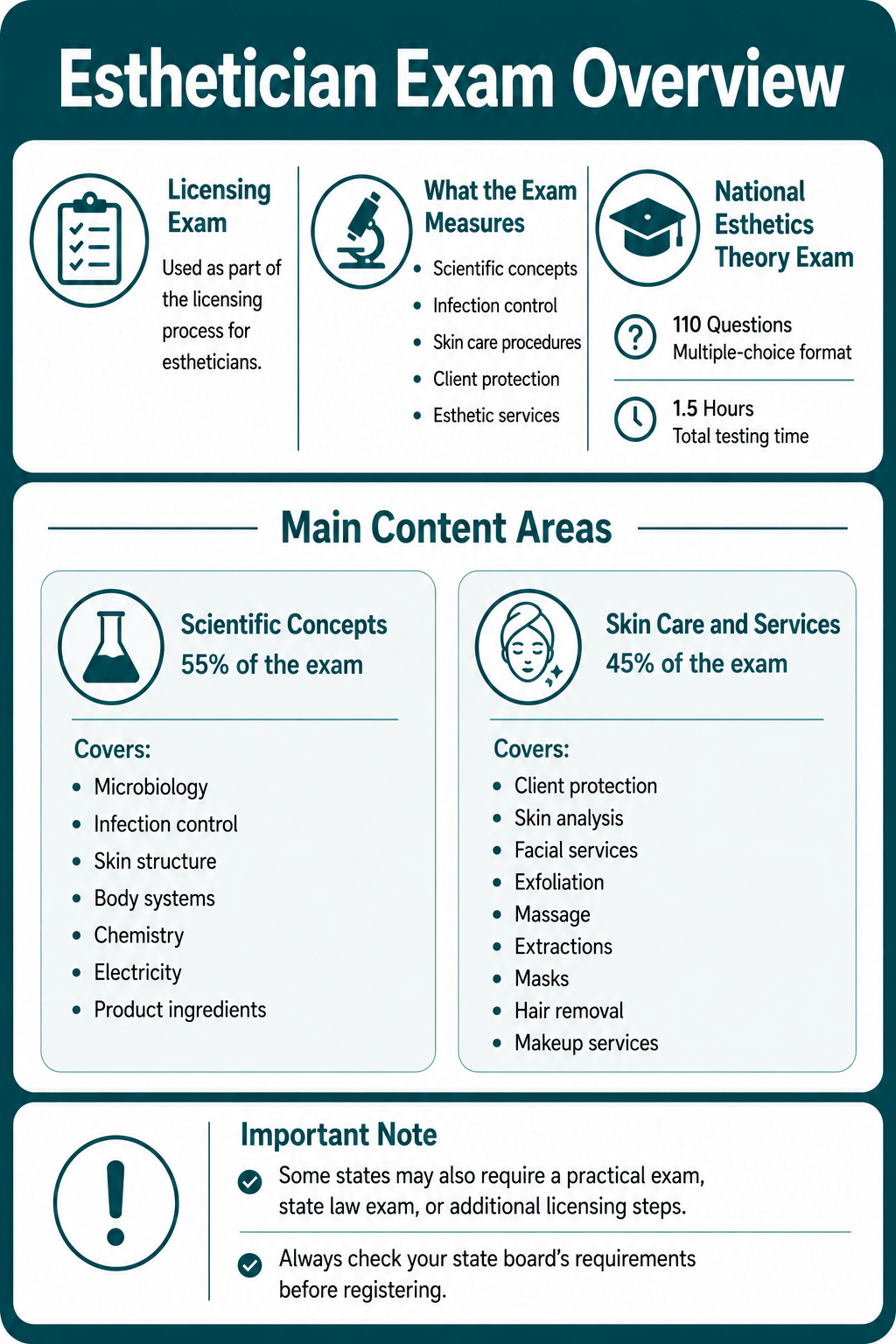
The topics on your exam depend on your state and testing provider. If your state uses the NIC National Esthetics Theory Examination, the theory exam is organized into two major domains: Scientific Concepts and Skin Care and Services.
Theory, Practical, and Written Practical Exams
Your state may require a theory exam, a practical exam, a written practical exam, a state law exam, or a combination of these. The theory exam tests knowledge. The practical exam evaluates hands-on procedures. The written practical exam tests procedure knowledge in a written or computer-based format.
NIC Esthetics Exam Structure
If your state uses NIC exams, your exact exam parts may vary. The current NIC Esthetics Theory exam includes 110 items, with 100 weighted items contributing to the final score. The current NIC Esthetics Written Practical exam includes 50 items, with 40 weighted items contributing to the final score.
Esthetician Sample Practice Questions
Try these original esthetician-style sample questions. These examples reflect common theory and practical-knowledge topics, but they are not actual NIC, PSI, Prometric, state board, or licensing exam questions.
1. Scientific Concepts: Microbiology
Which organism is most commonly associated with fungal skin infections such as ringworm?
- Bacteria
- Fungi
- Viruses
- Parasites
Show Answer and Explanation
Answer: B. Fungi
Ringworm is a fungal infection. Estheticians should recognize signs of possible contagious conditions and avoid performing services on affected areas.
2. Infection Control: Dropped Implement
During a facial service, an extraction implement falls to the floor. What should the esthetician do next?
- Pick it up, wipe it on a towel, and continue.
- Place it in the proper “to be disinfected” container and use a clean replacement implement.
- Place it back on the workstation and finish the service.
- Spray it with water and reuse it immediately.
Show Answer and Explanation
Answer: B. Place it in the proper “to be disinfected” container and use a clean replacement implement.
A dropped implement is contaminated. It should not be reused until it has been cleaned and disinfected according to the required procedure.
3. Skin Structure
Which layer is the outermost layer of the epidermis?
- Stratum corneum
- Stratum germinativum
- Dermis
- Subcutaneous layer
Show Answer and Explanation
Answer: A. Stratum corneum
The stratum corneum is the outermost epidermal layer. It helps protect the body and is a major focus in many basic skin-care services.
4. Skin Conditions: Contraindications
A client arrives for a facial with an active, weeping lesion near the mouth. Which action is most appropriate?
- Perform the facial but avoid mentioning the lesion.
- Cover the lesion with makeup before beginning the service.
- Postpone the service on the affected area and recommend medical evaluation when appropriate.
- Exfoliate the lesion to remove surface cells.
Show Answer and Explanation
Answer: C. Postpone the service on the affected area and recommend medical evaluation when appropriate.
An open, weeping, or possibly contagious lesion is a contraindication for service on the affected area. Estheticians should avoid unsafe service and should not diagnose medical conditions.
5. Basic Chemistry: pH
A skin-care product with a pH of 4.5 is best described as:
- acidic
- neutral
- alkaline
- sterile
Show Answer and Explanation
Answer: A. acidic
A pH below 7 is acidic. A pH of 7 is neutral, and a pH above 7 is alkaline.
6. Client Consultation
Before performing a chemical exfoliation service, which information is most important to review with the client?
- The client’s favorite makeup colors
- The client’s health history, medications, skin condition, and contraindications
- The brand of furniture in the treatment room
- The esthetician’s preferred music playlist
Show Answer and Explanation
Answer: B. The client’s health history, medications, skin condition, and contraindications
Consultation helps determine whether a service is appropriate and safe. Medications, recent procedures, skin condition, and contraindications can change the service plan.
7. Facial Massage Movements
Which massage movement is generally described as light, continuous stroking?
- Petrissage
- Tapotement
- Effleurage
- Friction
Show Answer and Explanation
Answer: C. Effleurage
Effleurage uses light, continuous stroking movements. Petrissage involves kneading, tapotement uses tapping movements, and friction uses rubbing pressure.
8. Hair Removal: Waxing Safety
A client asks for eyebrow waxing and says they recently used a prescription topical retinoid in the area. What is the safest response?
- Proceed with waxing because eyebrow skin is not sensitive.
- Use hotter wax so the service is faster.
- Evaluate the contraindication and postpone or modify the service according to state rules and manufacturer guidance.
- Wax the area twice to remove any irritated skin.
Show Answer and Explanation
Answer: C. Evaluate the contraindication and postpone or modify the service according to state rules and manufacturer guidance.
Certain medications or topical products can increase sensitivity and injury risk with waxing. The safest response is to evaluate contraindications before proceeding.
9. Practical Knowledge: Makeup Application
When applying makeup near the eye area, which technique best protects the client?
- Brace the hand to improve control and avoid unsafe pressure or slipping.
- Apply products as quickly as possible without stabilizing the hand.
- Use the same disposable applicator on both clients.
- Ask the client to hold the applicator.
Show Answer and Explanation
Answer: A. Brace the hand to improve control and avoid unsafe pressure or slipping.
Bracing helps maintain control when working near sensitive areas such as the eyes and mouth. It is also important to use clean tools and disposable applicators appropriately.
10. Written Practical-Style: Blood Exposure Procedure
A client has a minor blood exposure during a service. Which actions are appropriate parts of a safe response? Select all that apply.
- Put on disposable gloves before handling contaminated materials.
- Place contaminated disposable supplies in the proper receptacle.
- Ignore the exposure and continue the service as usual.
- Use an appropriate hand cleanser after the exposure procedure.
- Reuse contaminated supplies after wiping them with a dry towel.
Show Answer and Explanation
Answers: A, B, and D.
A blood exposure procedure requires barriers, proper disposal of contaminated materials, and appropriate hand cleansing. The exposure should not be ignored, and contaminated supplies should not be reused.
Esthetician Exam Registration
Registration rules differ by state. In many states, you must apply through the state board or an approved testing provider before scheduling your exam. Some candidates may need approval from a school, proof of completed training hours, or authorization from the licensing agency before they can test.
Before you register, review your state’s requirements carefully. You may need to submit proof of education, completed training hours, school completion, application approval, exam fees, valid identification, or other documents.
Before You Register
- Confirm your state’s licensing requirements.
- Check whether your state uses NIC, PSI, Prometric, Prov, DL Roope, PCS, or another testing provider.
- Find out whether you need a theory exam, practical exam, written practical exam, state law exam, or multiple exam parts.
- Review the current candidate information bulletin for your state.
- Confirm required training hours and school documentation.
- Check the exam fee, application fee, license fee, and retake fee.
- Make sure the name on your application matches the identification you will use on test day.
Esthetician Exam Cost
The cost of the esthetician exam varies by state and testing provider. Some candidates may need to pay separate fees for the theory exam, practical exam, written practical exam, license application, background check, or retake attempts.
Check directly with your state board or testing provider for the current fee schedule, payment rules, cancellation policy, rescheduling rules, and refund policy.
What to Expect on Test Day
Follow the instructions provided by your testing provider. Most testing centers require candidates to arrive early, show valid identification, complete check-in procedures, and store personal items before the exam begins.
If your state requires a practical exam, review the official candidate bulletin carefully. Practical exam rules may include required supplies, kit setup, sanitation steps, product labeling, disposal containers, workstation setup, timing rules, and task instructions.
Test-Day Checklist
- Arrive early for check-in.
- Bring the identification required by your testing provider.
- Do not bring prohibited electronics, notes, watches, bags, or unauthorized materials into the testing area.
- For practical exams, bring only the approved supplies listed in your current candidate bulletin.
- Label products and containers exactly as instructed.
- Use the required disposal containers for trash, soiled linens, and items to be disinfected.
- Maintain infection control and client protection throughout the exam.
- Follow proctor instructions and stop working immediately when time is called.
Esthetician Exam Scores
Scoring rules vary by state and testing provider. Some exams report a scaled score, while others may report only pass or fail status. Practical exams may include task-specific evaluation criteria, sanitation checkpoints, safety requirements, and critical steps that must be performed correctly.
There is no single passing score that applies to every esthetician candidate in every state. Review your current state candidate bulletin or testing-provider instructions for the score requirement that applies to you.
Retaking the Esthetician Exam
Retake rules vary by state. If you do not pass, you may need to wait before testing again, pay another exam fee, reapply through the state board, or follow additional instructions from your testing provider.
Before scheduling another attempt, review your score report or performance feedback. A strong retake plan should focus on the weakest areas first, especially infection control, skin science, contraindications, practical procedure steps, and state-specific rules.
How Can I Prepare for the Esthetician Exam?
Start by reviewing your state’s official candidate bulletin or exam content outline. This will show you which topics are tested and whether your state requires a theory exam, practical exam, written practical exam, state law exam, or some combination of exam parts.
Next, review the major content areas, including infection control, microbiology, skin structure, skin disorders, client protection, facial procedures, exfoliation, facial massage, hair removal, makeup, body treatments, product chemistry, electrical equipment, and blood exposure procedures.
Practice questions can help you become familiar with how exam topics may be presented. After each practice session, review missed questions carefully so you understand the correct answer and why the other answer choices are incorrect.
Esthetician Study Checklist
- Review microbiology, bacteria, viruses, fungi, parasites, and contagious conditions.
- Study sanitation, disinfection, sterilization, standard precautions, PPE, and blood exposure procedures.
- Review skin layers, glands, skin functions, skin lesions, skin disorders, and pigmentation conditions.
- Study basic chemistry, ingredients, product function, product labeling, and pH.
- Review client consultation, intake forms, treatment plans, contraindications, and documentation.
- Practice facial-service sequence, cleansing, steaming, exfoliation, massage, masks, moisturizing, sun protection, and home care.
- Review hair removal, eyebrow waxing, tweezing, makeup application, bracing, and infection control for tools and disposables.
- For practical exams, rehearse workstation setup, supply labeling, disposal containers, sanitation, timing, and cleanup.
- Use timed practice so you are comfortable with the pace of the theory or written practical exam.
- Review every missed question by identifying the exact rule, procedure, or safety concept involved.
Esthetician Study Resources
Best Online Course:
Top Study Guide:
High-Quality Flashcards:
Free Practice Resource:
Start Esthetician Prep with Mometrix
NIC, National-Interstate Council of State Boards of Cosmetology, PSI, Prometric, Prov, DL Roope, PCS, and other esthetics testing names are trademarks or names associated with their respective organizations. StudyGuideZone and Mometrix are not affiliated with or endorsed by NIC, PSI, Prometric, Prov, DL Roope, PCS, any state board, or any official esthetics licensing authority.